
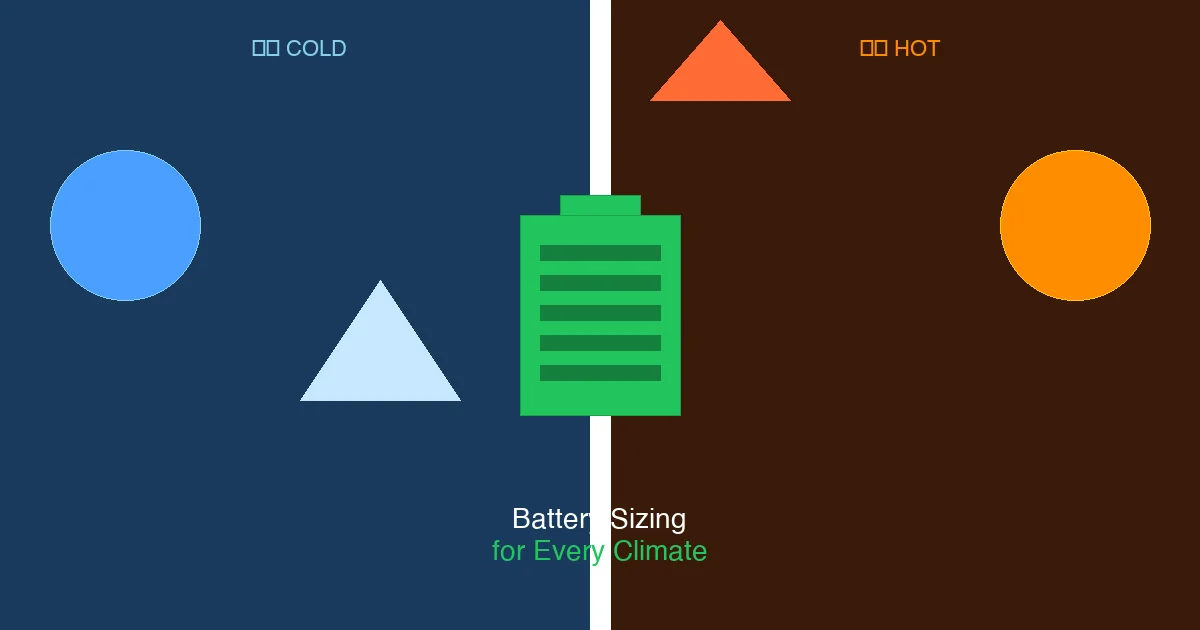
LiFePO4 Battery Sizing for Cold & Hot Climates: 2026 Guide
When installing a home energy storage system, most buyers focus on capacity (kWh) and power (kW). But there’s a critical variable many overlook: climate. The same 14kWh LiFePO4 battery bank will deliver dramatically different usable capacity in Canada’s winter versus Australia’s outback — even if everything else is identical.
This guide shows exactly how temperature affects LiFePO4 battery performance, how to correctly size your system for cold or hot climates, and what features to prioritize in extreme weather environments.
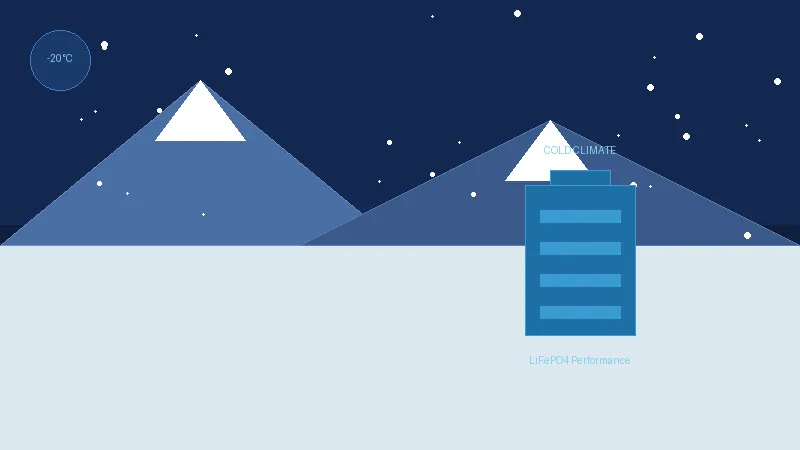
Why Climate Matters for LiFePO4 Battery Sizing
LiFePO4 (Lithium Iron Phosphate) batteries are celebrated for their thermal stability and safety — but they’re not immune to temperature. Unlike lead-acid, LiFePO4 doesn’t suffer permanent damage from cold, but it does experience:
- Capacity reduction — up to 20–30% at -20°C compared to 25°C baseline
- Voltage sag — higher internal resistance reduces discharge efficiency
- Reduced charge acceptance — cold batteries absorb charge more slowly
- Balancing complications — cold-temperature charging can cause uneven cell voltages
At high temperatures (above 45°C), the risks shift: accelerated calendar aging, thermal stress on cells, and reduced cycle life if cooling is inadequate. Insum Energy engineers regularly see 15–40% capacity discrepancies between systems installed in identical homes but vastly different climates.
Cold Climate Performance: How LiFePO4 Batteries Behave Below 0°C
Cold weather is the most common climate challenge for home battery sizing. Here’s what to expect at various temperatures:
| Temperature | Usable Capacity | Charge Efficiency | Notes |
|---|---|---|---|
| 25°C (77°F) | 100% | 99% | Optimal operating range |
| 10°C (50°F) | 95–98% | 92–95% | Minor reduction, minimal impact |
| 0°C (32°F) | 85–92% | 80–85% | Charge should be reduced |
| -10°C (14°F) | 70–80% | 60–70% | Discharge only; no charging below 0°C for unprotected packs |
| -20°C (-4°F) | 60–70% | Not recommended | Only BMS-protected cells with heating |
Note: These figures assume a quality BMS with low-temperature protection (LTP). Without LTP, charging below 0°C can cause lithium plating — a permanent degradation mechanism. Insum Energy’s managed battery systems all include configurable LTP thresholds.
Hot Climate Performance: Managing Heat Above 35°C
High-temperature operation presents a different set of challenges. Unlike cold weather (which temporarily reduces capacity), excessive heat accelerates permanent degradation:

| Cell Temperature | Cycle Life Impact | Calendar Aging | Recommended Action |
|---|---|---|---|
| 25°C (77°F) | 6,000+ cycles to 80% DoD | ~2% per year | Optimal |
| 35°C (95°F) | 5,000 cycles (-17%) | ~3% per year | Monitor, no action needed |
| 45°C (113°F) | 3,500 cycles (-42%) | ~5% per year | Improve ventilation |
| 55°C (131°F) | 2,000 cycles (-67%) | ~10% per year | Active cooling required |
The key insight: a battery that regularly operates at 45°C will have roughly half the lifespan of one kept at 25°C. For hot climate installations, thermal management isn’t optional — it’s essential to protecting your investment.
Cold Climate Battery Sizing: The 1.3× Rule
For cold climates (average winter temperature below 5°C), we recommend sizing your battery bank 30% larger than a temperate-climate calculation would suggest. This compensates for winter capacity losses.
Cold Climate Sizing Formula
Example: Daily consumption 20kWh, 2-day autonomy, cold climate:
Base = 20 × 2 ÷ 0.50 = 80kWh → Cold climate = 80 × 1.3 = ~104kWh
Cold Climate Must-Have Features
- Low-Temperature Protection (LTP) — Automatically stops charging below 0°C
- Self-heating function — Built-in heating pads warm cells before charging
- Insulated battery enclosure — Maintains stable internal temperature
- Interior installation — Garages and basements avoid direct outdoor exposure
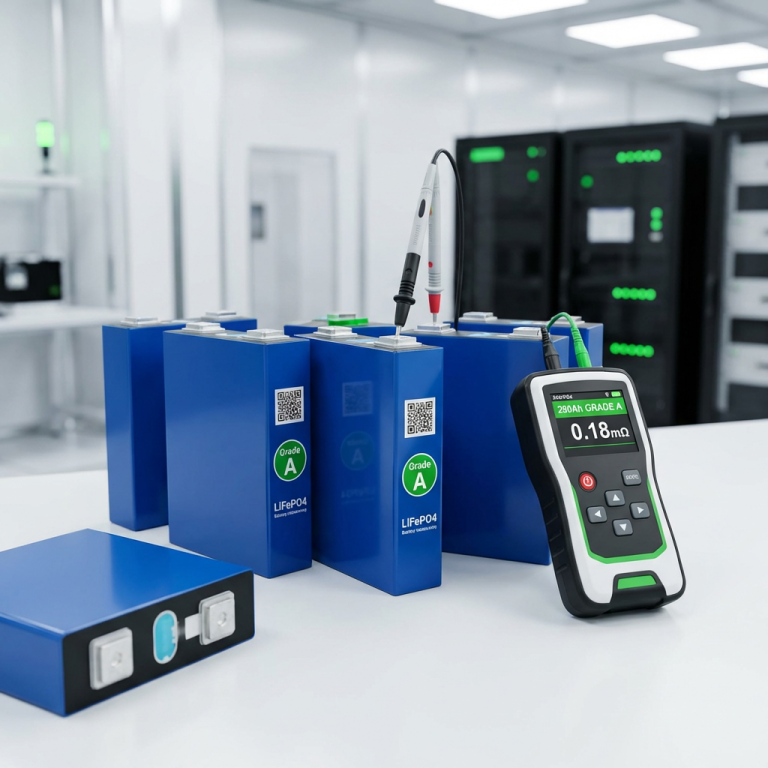
- High-quality cells — Grade A cells with consistent low-temperature performance (CATL, EVE, REPT recommended)
Hot Climate Battery Sizing: Prioritize Longevity
Hot climate sizing follows a different logic: it’s not just about capacity, but about preserving cycle life. For areas with sustained high temperatures (Middle East, Australia, Southern US, Mediterranean):
Hot Climate Sizing Formula
Example: Daily consumption 20kWh, 2-day autonomy, hot climate:
Base = 20 × 2 ÷ 0.80 = 50kWh (adjusted DoD) + 15% thermal buffer = ~58kWh
Hot Climate Must-Have Features
- Active ventilation or AC cooling — Keep cells below 35°C during peak summer
- Temperature-aware BMS — Reduce charge/discharge rate when cells exceed 40°C
- Shaded installation — Avoid direct sunlight on battery enclosures
- Thermal隔离 housing — Insulated from external heat sources
- Lower depth of discharge (DoD) strategy — 80% DoD instead of 90–100% extends cycle life dramatically
Climate-Specific Battery Recommendations by Region
| Region | Climate Type | Recommended Capacity Buffer | Key Features | DoD Setting |
|---|---|---|---|---|
| Canada, Scandinavia, Northern Europe | Extreme cold (-30°C to 0°C) | +30% | LTP, self-heating, insulated enclosure | 50% |
| UK, Ireland, Netherlands | Temperate (0°C to 25°C) | +10% | Standard BMS, indoor install | 80% |
| Germany, France, Central Europe | Continental (-15°C to 35°C) | +20% | LTP + ventilation, all-season enclosure | 80% |
| Australia (outback), Middle East | Extreme heat (35°C to 55°C) | +15% (thermal buffer) | Active cooling, thermal management | 80% |
| Spain, Italy, Greece, California | Hot summer (0°C to 42°C) | +15% | Ventilation, temperature-aware BMS | 80% |
| Singapore, Thailand, Brazil (tropical) | Hot-humid (25°C to 38°C) | +10% | Humidity-resistant enclosure, active cooling | 80% |
Thermal Management Solutions for Extreme Climates
For Cold Climates
- Battery-integrated heating — Self-heating packs (available from JK BMS, Daly, and SEPLOS) draw ~50W to warm cells to 5°C before accepting charge
- Installation location — Always install in conditioned or insulated spaces (not outdoor sheds in cold climates)
- Insulation jackets — Retro-fit neoprene or foam enclosures maintain temperature for 6–12 hours during power outages
- Solar pre-warming — In off-grid systems, use excess solar generation to activate heating before charging
For Hot Climates
- Active ventilation — USB fans or purpose-built AC cooling units ($200–$800) can reduce battery room temperature by 10–15°C
- Dedicated battery room — Separate from inverter/boiler heat sources, ideally with AC supply
- Reflective insulation — White/polished enclosures reflect solar radiation
- Temperature monitoring — Real-time BMS temperature alerts via app (Insum Energy’s systems include remote monitoring)
- Phase-change materials (PCM) — Advanced thermal mass solutions absorb peak heat loads
Climate Sizing Calculator: Quick Reference
Use this quick formula to estimate your climate-adjusted battery size:
Temperate: (Daily kWh × Autonomy Days) ÷ 0.80 ÷ 0.90
Cold Climate: (Daily kWh × Autonomy Days) ÷ 0.50 × 1.30
Hot Climate: (Daily kWh × Autonomy Days) ÷ 0.80 ÷ 0.80 × 1.15
Note: 0.80 is the assumed inverter efficiency. Adjust based on your actual inverter spec.
Common Mistakes in Climate-Adjusted Battery Sizing
- Ignoring winter capacity loss — Installing a system sized for summer conditions, then facing backup shortfalls in January
- Installing batteries outdoors in cold climates — Unheated garages or outdoor enclosures can freeze batteries
- Neglecting heat from inverters — Placing batteries adjacent to inverters adds 5–10°C to ambient temperature
- Setting DoD too aggressively in hot climates — 100% DoD cycles in 40°C+ environments can halve battery lifespan
- Skipping BMS temperature protection — The cheapest insurance for extreme climate installations
Conclusion: Climate-Responsive Sizing Is Non-Negotiable
Whether you’re in Canada’s Yukon or Queensland’s interior, your LiFePO4 battery sizing must account for real-world climate conditions — not just datasheet specifications measured at 25°C. A properly climate-sized battery system delivers reliable backup year-round, protects your investment from accelerated degradation, and maximizes your return on home energy storage.
The formulas in this guide are starting points. For a professional site assessment that accounts for your specific climate zone, installation environment, and usage patterns, contact Insum Energy’s technical team. We provide free system sizing consultations for residential and commercial installations across all climate zones.
Frequently Asked Questions
Can LiFePO4 batteries be installed outdoors in cold climates?
Yes, but only with a heated enclosure or self-heating BMS. Standard outdoor installations are not recommended below -10°C without active heating. The battery should be in a conditioned space whenever possible.
What’s the best temperature range for LiFePO4 batteries?
The optimal operating range is 15–35°C (59–95°F). Most quality BMS systems will throttle charge/discharge rates above 40°C and below 0°C to protect cell integrity.
How much does cold weather reduce LiFePO4 capacity?
At 0°C, expect 85–92% of rated capacity. At -20°C, expect 60–70%. With self-heating enabled, the impact is significantly reduced, and you can recover near-full capacity once cells warm up.
Does hot weather void LiFePO4 battery warranty?
Most manufacturer warranties require operating temperatures within stated limits (typically 0–45°C). Operating above 45°C regularly without adequate cooling may void warranty claims. Always review warranty terms for temperature exclusions.
Ready to design the right climate-adjusted battery system for your home? Get a free sizing consultation from Insum Energy today.
One Comment