Greenhouse Battery Storage in NL & Spain: 2026 Grower Guide
A greenhouse is the most industrial customer in agriculture: grow lights, heat pumps, irrigation pumps and climate computers run thousands of hours a year on a business tariff. That makes growers a natural market for battery storage — but not the way homeowners buy it. A battery in a Dutch greenhouse solves a completely different problem than one under plastic in Almería — and in 2026 the Dutch grid has changed the rules every grower should understand before quoting storage.
Two Greenhouse Economies, Two Battery Cases
The Netherlands operates about 8,490 hectares of glass at specialised businesses — 4,799 hectares of vegetables, 1,731 of cut flowers and 1,903 of pot plants across 2,311 holdings worth roughly €7.9 billion (Glastuinbouw Nederland, Kengetallen 2026). The sector still burns about 2.94 billion m³ of natural gas a year, nearly a third of it in combined heat and power (CHP) units whose electricity is exported to the grid. But that model is being dismantled on purpose: the sector’s reduced energy-tax rate is being phased out and a sector-specific CO₂ levy has applied since 2025, so the strategy is electrification — heat pumps instead of gas boilers, LEDs instead of SON-T lamps.
Spain is the mirror image. Almería holds 33,400 hectares of greenhouses — 83% of Andalusia’s 40,304-hectare total — producing year-round vegetables under more than 3,000 hours of sunshine a year (UAL-ANECOOP Foundation). There is almost no assimilation lighting: the load is irrigation pumping, ventilation and shade systems, most of it running in daylight hours that align naturally with on-site solar.
Netherlands: Electrification Meets a Congested Grid
Ten of twelve Dutch provinces already face or expect grid capacity shortages, and from 1 July 2026 even small-business connection requests join the same national queue as industrial ones, ranked by a new ACM prioritisation framework (CMS on the Schenkeveld case law and grid rules). Storage operators sit in the first priority group — “congestion relievers” — because a battery creates usable capacity behind an existing connection instead of demanding new copper. The Energiewet, in force since 1 January 2026, formally recognises energy storage as an activity in its own right, so a grower who stores and trades flexibility keeps normal customer rights.
Growers have form here: in the Schenkeveld case a greenhouse company fought Liander over a refused transport-capacity increase and won the principle that grid operators must exhaust congestion management before saying no. If your LED retrofit is stuck behind a capacity refusal, a battery is now the fastest route to “yes” — often faster than waiting for network reinforcement.
On the subsidy side, the SDE++ 2026 round opens 27 October and closes 26 November 2026, with heat-pump electrification categories relevant to horticulture among the options. And batteries themselves qualify for the Energy Investment Allowance (EIA): in 2026 growers can deduct 40% of the investment from taxable profit from a €460 million budget, provided the system meets the Energy List conditions — including a minimum of roughly 5 kW / 15 kWh capacity, optimisation software, and at least 75% of stored energy coming from the company’s own renewable generation on the same connection. A backup-only battery does not qualify.
Spain: Cheap Sun, but the kWh Math Still Works
Spanish growers pay far less per kilowatt-hour than their Dutch competitors. In the first half of 2026, non-household electricity including taxes averaged €0.2453/kWh in the Netherlands for the 500–1,999 MWh band typical of a one-hectare lit operation, against €0.1604 in Spain and an EU-27 average of €0.2146 (Eurostat nrg_pc_205, H1 2026).
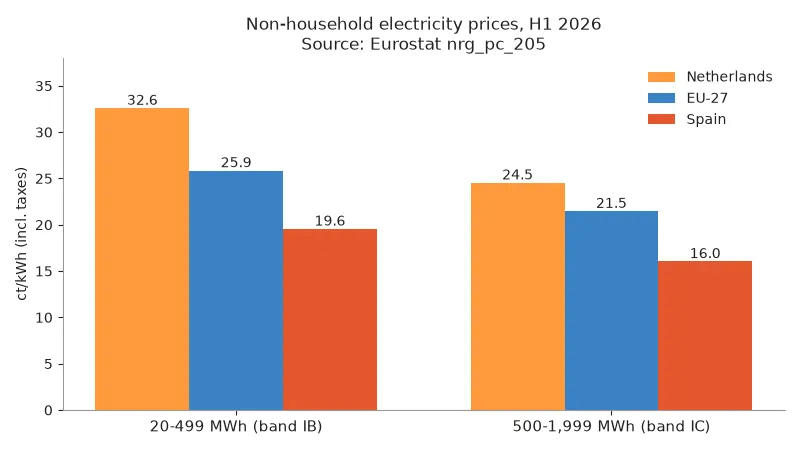
That price gap is the honest starting point: a Spanish greenhouse gets less value per stored kWh than a Dutch one. But the Spanish case works on shape, not rate. Most greenhouse load — pumping, cooling fans, fertigation — runs in daylight, so PV alone covers it; the battery’s job is the residual evening and night load, plus protection when a cloudy week collides with a full irrigation schedule. Spanish rules are friendly: Royal Decree 244/2019 explicitly permits storage in self-consumption installations and needs no separate grid-access permit for the battery itself, and businesses on the 6.1TD tariff can shave the expensive P1/P2 peak periods.
Sizing: What a Battery Actually Does per Hectare
Start from the load, not the catalogue. Assimilation lighting is the big variable: a lit Dutch cucumber or tomato house draws roughly 250–400 kW at peak with 16–18-hour winter days — several megawatt-hours daily. No battery touches that scale alone, and it never replaces the CHP unit or gas boiler; it shapes load around them. A working ladder:
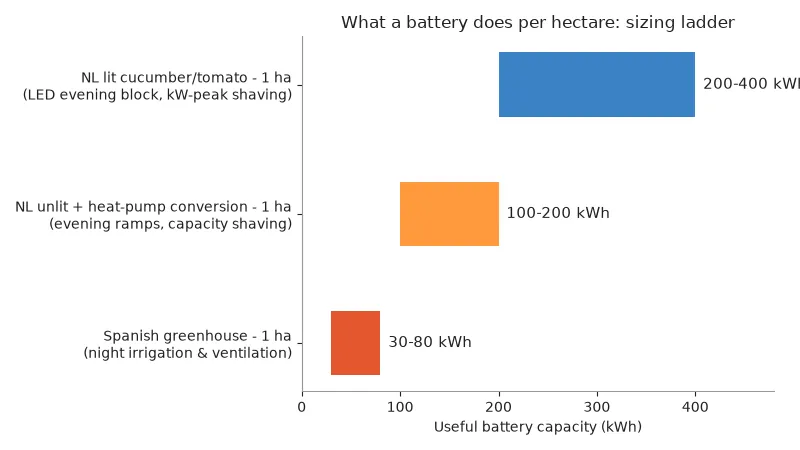
- Unlit NL greenhouse with heat-pump conversion: 50–150 kW of new electrical load per hectare; a 100–200 kWh battery covers evening heat-pump ramps and shaves the contracted capacity peak.
- Lit NL operation: 200–400 kWh shifts the LED evening block into cheaper hours and trims the transport-capacity tariff; the battery also absorbs midday solar or CHP surplus that would otherwise spill.
- Spanish 1 ha: 30–80 kWh carries night irrigation and ventilation; PV of 50–150 kWp per hectare does the heavy lifting in daytime.
One sizing rule growers routinely get wrong: under a zero-export or capacity-limited connection, you size to the load profile, not the roof area — the same logic we set out in our zero-export guide.
Where the Money Comes From
For a Dutch grower on a large connection, transport costs follow contracted capacity in kW, not just kWh consumed — so peak shaving has a line-item return, and grid operators are experimenting with congestion-management contracts that trade tariff discounts for guaranteed flexibility. On pure arbitrage, stored electricity is worth roughly the retail rate times round-trip efficiency: about €0.22/kWh in the Netherlands and €0.14 in Spain, against €0.05–0.08 earned from exporting the same unit (Eurostat H1 2026). That 3–4× gap between storing and exporting is the structural argument for batteries in every EU greenhouse, whatever the crop. Spanish growers get the same logic with a twist: high irradiation means near-daily solar cycles, and irrigation is fully schedulable, so the control software chases value rather than crop emergencies.
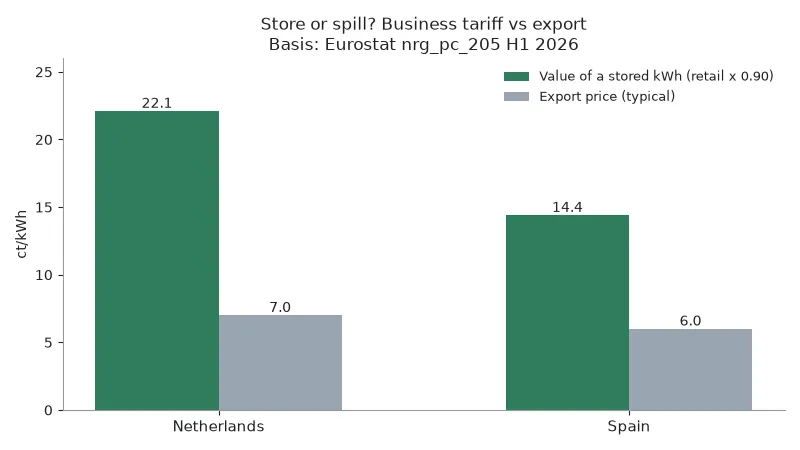
Two more revenue lines worth negotiating: demand-response and flexibility markets are opening to mid-size assets through aggregators (the same mechanics we covered in our capacity-mechanism guide), and export tariffs for surplus CHP or PV output keep falling across Europe — one more reason to store, not spill.
The Subsidy Map for Growers, 2026
Household schemes dominate the subsidy landscape, and most of them stop at the greenhouse gate. What growers can actually use:
| Country | Scheme | What it covers | Greenhouse reality |
|---|---|---|---|
| Netherlands | EIA 2026 (RVO) | 40% profit deduction, ≥15 kWh systems tied to own renewables | Yes — the main route; SDE++ for heat electrification |
| Spain | RD 244/2019 | Legal framework, surplus compensation | Framework only; regional battery grants closed in 2026 |
| Germany | KfW 270 | Low-interest loan for solar + storage | Businesses included in KfW loan programmes |
| France | MaPrimeRénov’ | Residential renovation | No — households only |
| Italy | Conto Termico 2.0 (GSE) | Up to 65% of thermal-renovation costs | Partially — admits some business installations |
| Poland | Mój Prąd / PME 2 | Up to 30% of battery cost | No — households only |
| Czechia | NZÚ (SFŽP) | Battery subsidies for homes | No — and calls have been paused |
| Greece | HDB rooftop programme | 45–75% grant for PV + storage | Household-focused; check business calls separately |
The pattern repeats across the EU: where household grants dominate, growers’ money comes from tax deductions, loans and grid-related contracts instead. That is exactly the picture in our wider review of EU power-price outlooks to 2030 — business storage value comes from tariffs and network signals, not rebate cheques.
Install Notes: Heat, Humidity and Certification
Greenhouses are a hostile electrical environment: humidity swings, condensation, and 30 °C-plus summer nights. Specify cabinets rated IP54 or better for indoor plant rooms, keep inverters out of misting zones, and derate for summer temperatures — LFP chemistry prefers 15–30 °C and the BMS protects it with charge blocks otherwise. Grid compliance is non-negotiable: inverters must meet EN 50549-2 for MV/LV connections and the battery must carry CE marking under Regulation (EU) 2023/1542 (EUR-Lex text). If the battery shares the meter with a CHP unit, check the export scheme first — mixing subsidised feed-in with battery cycling needs the right metering setup, as we explain in our storage-metering guide.
The Bottom Line for Growers
In the Netherlands, a battery is increasingly the price of admission to your own electrification project: it converts a refused capacity request into a queued-with-priority one, cuts the kW bill and earns the 40% EIA deduction. In Spain, it is a modest, fast-cycling asset that turns Almería’s sunshine into night-time irrigation with near-daily payback. Same hardware, two business cases — both depend on reading your own load profile before your supplier quotes a box. For the open-field counterpart, see our agrivoltaics guide; the Insum Energy product range lists stackable LiFePO4 systems suited to plant-room duty.
Planning a greenhouse retrofit with storage? Contact Insum Energy for a sizing quote built on your load curve, or browse insumenergy.com for more grower-focused guides — and learn more about our EU-wide operations. Dutch growers should run the numbers before the SDE++ window closes on 26 November.