Ground-Mount Solar + Battery: EU Garden Array Guide 2026
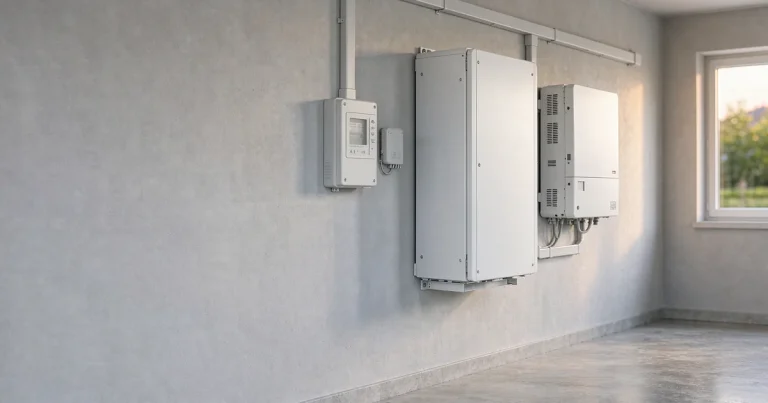
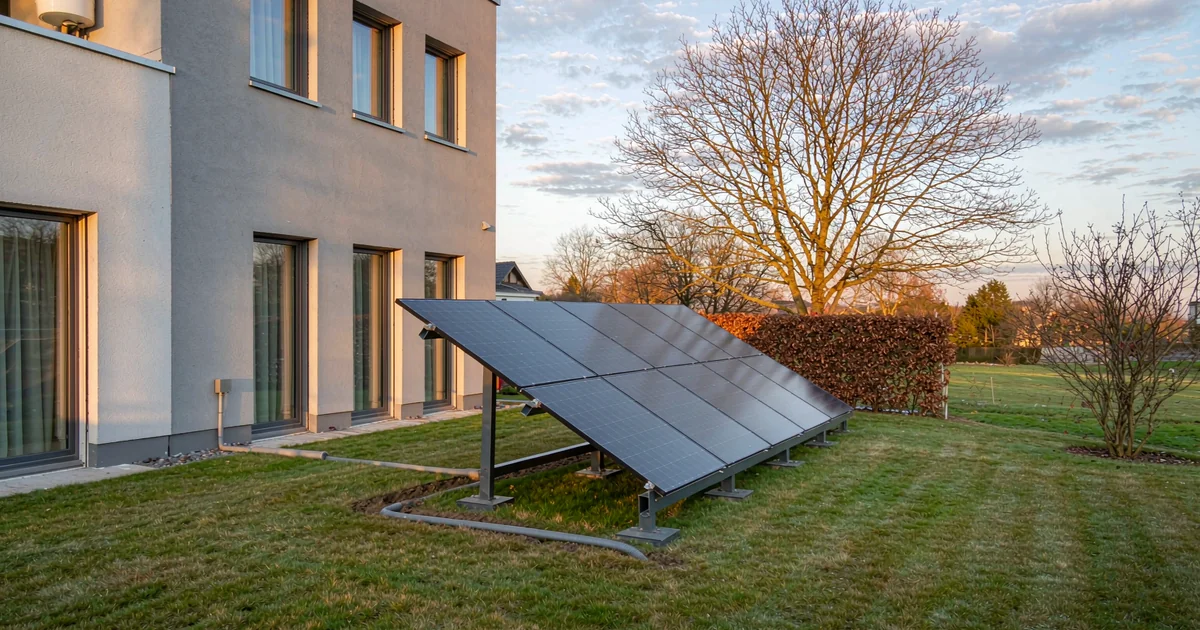
Every few weeks an installer sends Insum Energy the same photograph: a row of modules on grass, a trench, and a battery cabinet on a garage wall. The roof said no — too small, too shaded, too old, or listed — so the array moved into the garden. On paper the move looks free. In practice it is a different asset class: a different permit route, a different feed-in rate, and a cable run that can swallow the saving.
Why a garden array at all
Three cases justify one. The roof cannot carry the load — a 6 kWp roof on a heat-pump house with an EV is a rounding error. The roof is full and the household still imports. Or the geometry is wrong: a north pitch, a chimney shadow across the south plane, a thatched roof where mounting is forbidden. What you gain is control — the tilt your latitude wants, row spacing that keeps December shadows off the next row, walk-up service, 3–8% bifacial gain. What you lose is land, a fence, and the assumption that solar is permitted development.
What it costs, and why €700/kWp is a trap
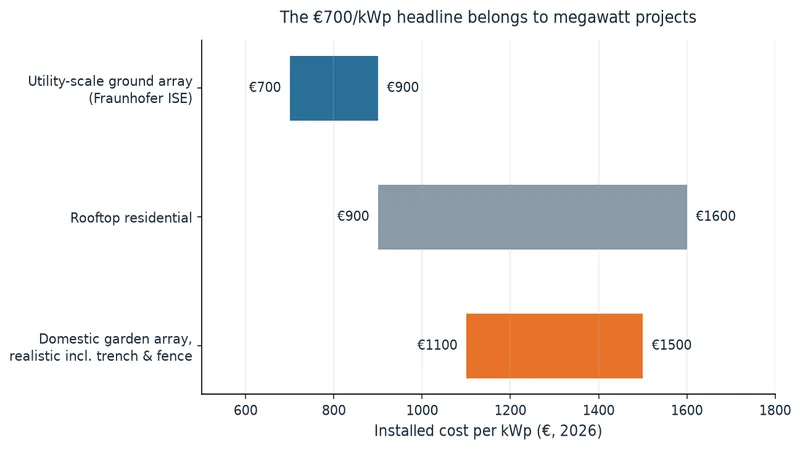
Fraunhofer ISE’s Photovoltaics Report puts ground-mounted systems at €700–900/kWp and rooftop systems at €900–1,600/kWp, with levelised costs from 4.1 ct/kWh for large ground arrays to 12.0 ct/kWh for small difficult roofs. Those ground figures describe megawatt projects: one trench, one connection, one fence, 5,000 modules. None of it shrinks to 12 kWp — the trench still costs €15–40 per metre and the fence €40–70.
Budget €1,100–1,500/kWp installed for a domestic garden array — roughly rooftop money. Against €0.2832/kWh across the EU and €0.3618/kWh in Germany in the first half of 2026 (Eurostat electricity prices), that still works, but it is not the bargain the headline suggests.
| What changes | Roof array | Garden array |
|---|---|---|
| Structure | Rail on existing roof | Ground screws or ballast |
| Installed cost, 10–12 kWp | €900–1,600/kWp | €1,100–1,500/kWp |
| Area needed | 6–8 m²/kWp of roof | 15–25 m²/kWp with row spacing |
| Permit route | Often none or notification | Usually a planning decision |
| Feed-in tariff | Building rate | Lower “other installation” rate |
| Cable route | 10–20 m | 30–80 m, partly buried |
| Shading | Fixed by the roof | Designed: tilt, spacing, azimuth |
The permit question: one month, or one year?
EU law sounds generous. Article 16d(2) of the recast Renewable Energy Directive (Directive (EU) 2023/2413) requires member states to decide permits for solar installations of 100 kW or less within one month, and silence counts as approval, provided the array does not exceed existing grid connection capacity. States may lower that threshold, but not below 10.8 kW. Read the small print, though: one month is a deadline for a decision, not an entitlement to build. If planning law says the field may not host an array, the authority answers within a month — and the answer is no.
Germany shows how narrow the gate is. The statutory tariff in §48(1) No. 1a of the EEG reaches a ground-mounted array only if four conditions hold: the plot lies inside a built-up area within the meaning of §34 BauGB; a dwelling stands on it at commissioning; that dwelling is structurally unsuitable for a roof array; and the array’s footprint does not exceed the dwelling’s, at no more than 20 kW. That is an exception written for one situation — the house that cannot take panels. Outside it, a garden array is a field power plant, and field plants live or die in the building plan.
France is more mechanical. Under service-public.fr F31923, a ground array below 3 kW and 1.80 m high needs no formality; above 1.80 m it needs a déclaration préalable, which remains the route up to 1,000 kW, and a permis de construire above that. France also applies its taxe d’aménagement to ground panels at €10/m².
Spain, Italy, the Netherlands and Poland repeat the pattern in different vocabulary: self-consumption is regulated nationally, but the right to put a structure on open land is municipal or regional. Ask the commune before ordering modules — a refused array is a stranded asset with a 25-year design life.
The tariff trap: a field is not a roof
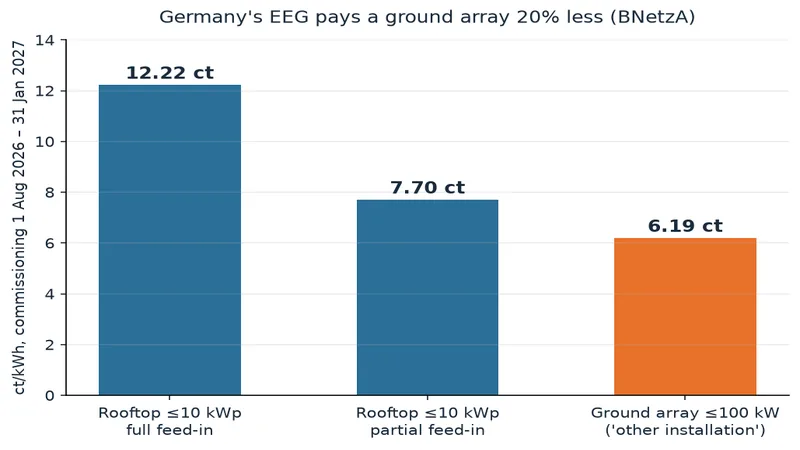
Germany prices the difference explicitly. For commissioning between 1 August 2026 and 31 January 2027, a rooftop system up to 10 kWp earns 7.70 ct/kWh on partial feed-in, while “other installations” up to 100 kW earn 6.19 ct/kWh — the rate that applies to a ground array (BNetzA EEG rates). A 20% haircut for the same electron, and only if the site qualifies.
Follow it one step further. If the array cannot earn a tariff, it becomes a self-consumption machine and the battery stops being an optimisation — it becomes the business model. Where a DSO caps feed-in, every kWh the battery absorbs is a kWh the array may still produce, as our guide to zero-export limits and battery control sets out; which is also why curtailment and battery capture matter more for ground arrays than for roofs.
The cable run is where garden arrays lose money
A string at 600–800 V DC loses very little over 50 m; a 230 V AC cable carrying a 6 kW array loses a great deal. At 26 A, 50 m of 6 mm² single-phase cable drops 4.3% of production — a silent tax on every kWh for 25 years.
| Cross-section | 230 V, 30 m | 230 V, 50 m | 400 V 3-phase, 30 m | 400 V 3-phase, 50 m |
|---|---|---|---|---|
| 6 mm² | 2.6% | 4.3% | 0.4% | 0.7% |
| 10 mm² | 1.5% | 2.6% | 0.3% | 0.4% |
| 16 mm² | 1.0% | 1.6% | 0.2% | 0.3% |
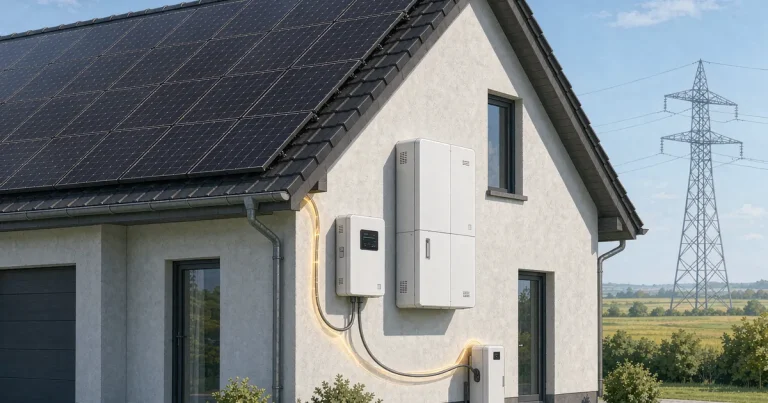
Voltage drop at full output, copper at 70 °C. Keep DC below 1% and AC below 1.5% and the design writes itself: run the DC side long and the AC side short, which puts the hybrid inverter in the house, not in a shed at the array.
The trench is the expensive part. Use double-insulated H1Z2Z2-K cable to EN 50618 even underground, in conduit at 0.6 m with warning tape, surge protection at both ends and bonding back to the house earth. At 40 m the trench alone is €600–1,600 — precisely the sum the cheaper structure was meant to save.
Winter: the ground array’s gift and its bill
Ground mounting lets you pick a tilt roofs rarely allow. In central Europe the annual optimum sits near 35°, but 55–60° shifts production towards December and January — at the cost of 10–15% of annual yield and wider row spacing, because a steeper row casts a longer shadow. PVGIS models the monthly split.
No tilt fixes the seasonal gap: a December day in Munich delivers roughly a tenth of a June day, and a 20 kWh battery cannot bridge that. Size storage on the evening load, not on nameplate.
Sizing the battery behind a garden array
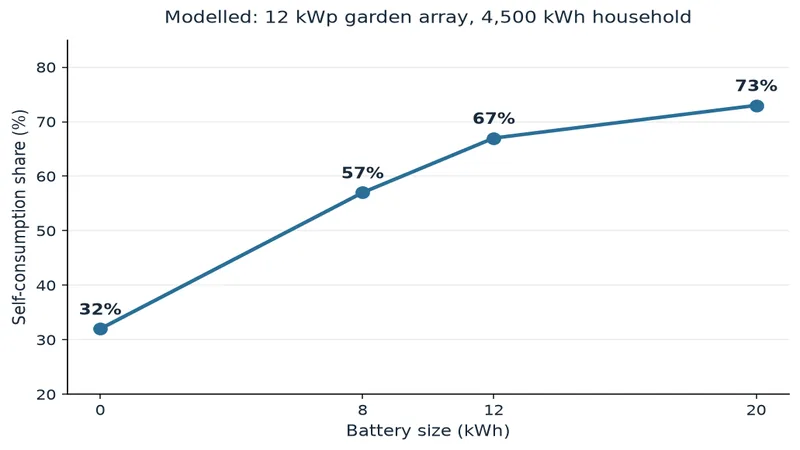
A garden array is usually larger than the roof it replaced, so the battery works harder. The rule still holds: one cycle a day, sized to the load after sunset. For a 12 kWp array, a 4,500 kWh household and no heat pump, modelled self-consumption runs from about 32% with no battery to 57% at 8 kWh, 67% at 12 kWh and 73% at 20 kWh. The last 8 kWh buys six points; the first 8 kWh buys twenty-five.
Value per stored kWh is retail price times round-trip efficiency: at 90%, 25.5 ct in the EU average and 32.6 ct in Germany, against 6.19–7.70 ct for exporting it — a factor of three to four, and the arithmetic behind our 2027–2030 price outlook. If the array sits far from the meter, settle the metering question early: a second meter or one bidirectional unit changes cost and tariff eligibility, as our metering guide explains.
Insurance and land tenure
Two details sink more projects than planning. A ground array is often not covered by a household policy — declare it, or the storm that lifts a module is your invoice. If the land is leased or jointly owned, the array is a fixture you may not have the right to install. And avoid the low point of the plot: a flooded array is a claim, not a warranty case, as our flood-zone siting rules describe.
The bottom line
Do the checks in order: land-use answer, tariff eligibility, trench cost, array size, battery size. Get the first two wrong and the array is an ornament; get them right and it beats a compromised roof, because you design the tilt, spacing and storage around the load instead of the rafters.
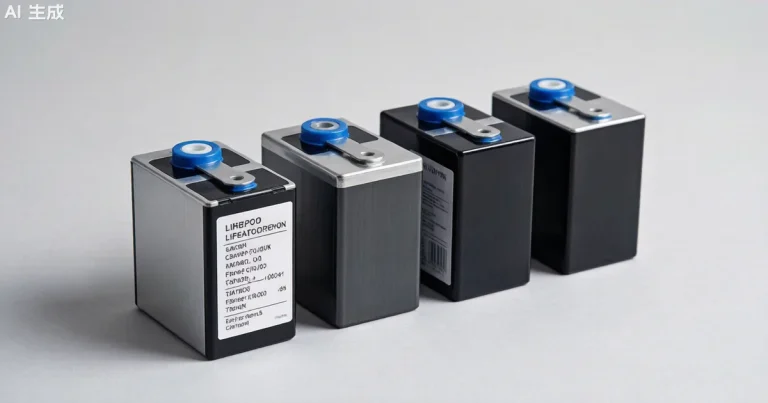
Insum Energy builds LiFePO4 storage for these layouts — indoor or outdoor cabinets, 5 to 30 kWh, 8,000 cycles at 80% DoD — and supplies installers across 27 EU markets. Browse the product range, read about our manufacturing, or contact our team for a sizing quote on your garden array. For the roof-first route, our EU rooftop mandate guide covers what the EPBD requires.