Solar Diverter vs Battery: Hot Water or Storage in the EU?
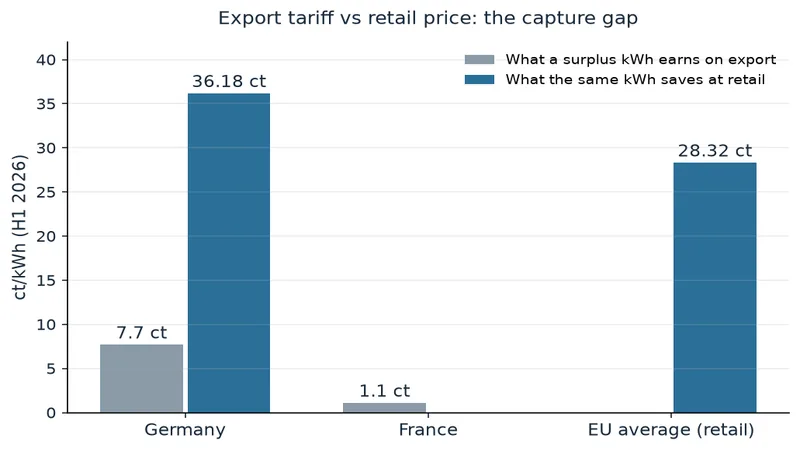
Your rooftop PV gives every surplus kilowatt-hour three destinations: the grid, the hot water cylinder, or a battery. In 2026 the first one got dramatically worse for most EU homes. Germany cut its small-system feed-in rate to 7.70 ct/kWh, France cut its surplus tariff to just 1.1 c€/kWh, and Spain pays no fixed rate at all — just the hourly market price. Against a retail price that still averages 28.32 ct/kWh across the EU, exporting surplus is close to giving energy away. That forces the real question: is it smarter to park surplus PV in water or in lithium?
What a solar diverter actually does
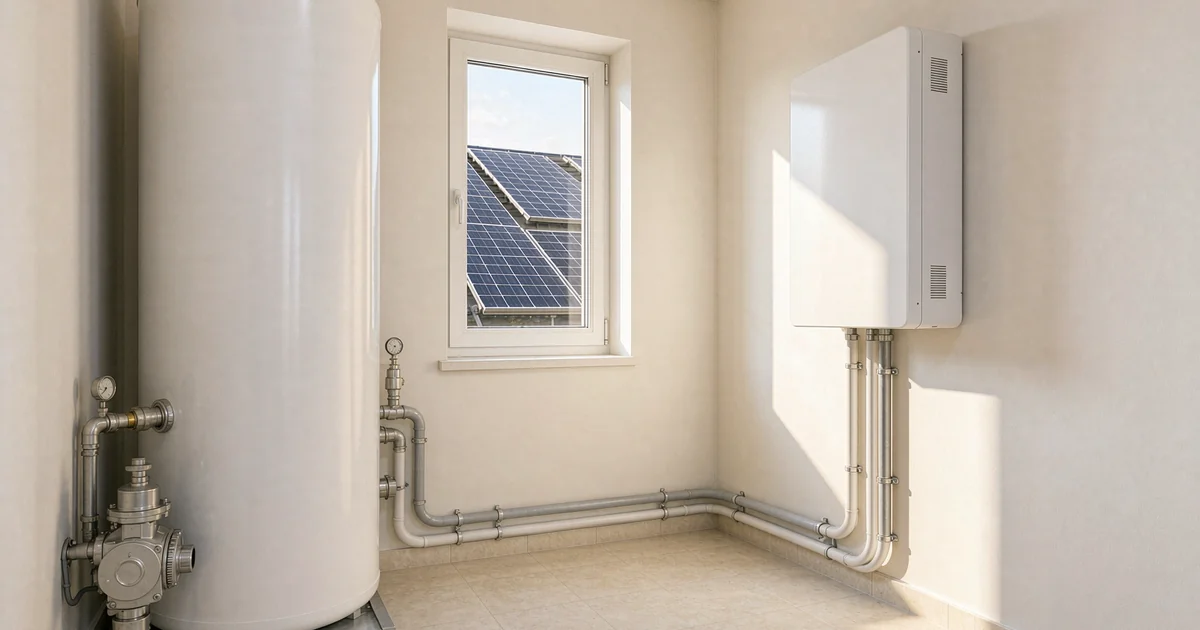
A solar diverter (sold under names like myenergi Eddi or Solar iBoost) is a small device that watches your generation and household load, and pushes any surplus PV straight into the resistive heating element of your hot water cylinder. There is no chemistry, no conversion chain and no degradation — a resistive element turns electricity into heat at essentially 100% efficiency, so one surplus kWh becomes one kWh of hot water. Hardware costs roughly €400–900 installed, about a tenth of an entry-level home battery, and it has no round-trip losses to apologise for.
The limitation is the store itself. A typical 200–300 litre cylinder only holds about 10–15 kWh of usable heat, it cannot run your lights or washing machine, and it can only absorb surplus while the tank has room. Legally, the diverter counts as a load on your installation, not a generating plant, so in most member states it needs no grid connection change, no feed-in declaration and no separate meter — a genuine advantage over storage, where metering configuration can decide the economics, as our storage metering guide explains. A diverter is therefore a one-purpose buffer: brilliant at what it does, useless for everything else.
What your surplus kWh earns — and what it saves
Compare the two sides of the trade. Exporting a surplus kWh in 2026 earns you 7.70 ct in Germany on partial feed-in up to 10 kWp (BNetzA EEG rates, commissioning 1 Aug 2026), a flat 1.1 c€ in France under the arrêté of 1 June 2026 for systems up to 9 kWc (service-public.fr), or the hourly wholesale price in Spain under the compensated-surplus scheme of RD 244/2019 — often a few euro-cents at midday, exactly when your surplus appears.
Using that same kWh yourself saves the full retail price: €0.2832/kWh EU average in the first half of 2026, €0.3618 in Germany, €0.3142 in Italy and €0.2509 in Spain (Eurostat nrg_pc_204). Every surplus kWh you divert or store instead of exporting is therefore worth roughly 4 to 5 times more in Germany and over 25 times more in France. This gap — not hardware marketing — is why surplus-capture devices now sell so well.
Cost per stored kWh: diverter vs battery
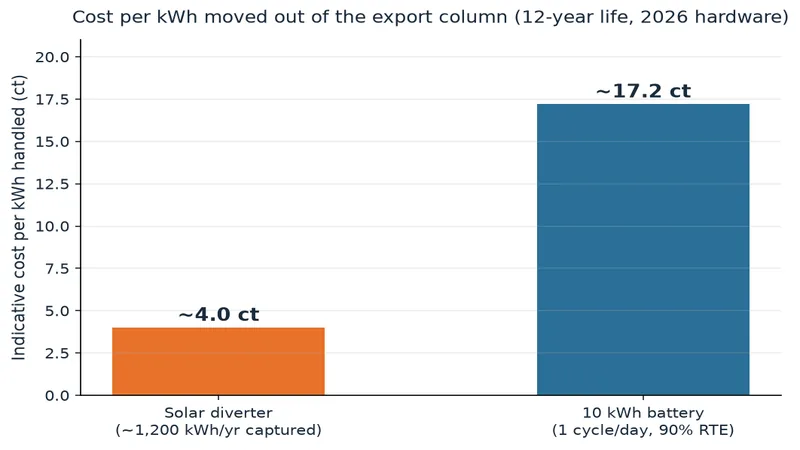
The cleanest comparison is the cost of the equipment per unit of energy it actually moves out of the export column. Take a €600 diverter capturing 1,200 kWh of surplus per year over a 12-year service life: that is about 4 ct per kWh handled. A 10 kWh home battery at €6,800 installed, cycling once a day at ~90% round-trip efficiency over 12 years, lands closer to 17 ct per kWh. The battery handles five times the volume and much more valuable electricity — but the diverter wins the unit-cost contest on the energy it can reach.
Table 1 — Diverter vs battery at a glance (EU, 2026):
| Solar diverter | 10 kWh battery | |
|---|---|---|
| Hardware + install | €400–900 | €5,000–8,800 |
| Efficiency (surplus → useful output) | ~100% (heat) | ~90% (electricity) |
| What it can serve | Hot water only | Everything in the house |
| Daily capacity | 10–15 kWh heat (cylinder-limited) | ~9 kWh usable electricity |
| Indicative cost per kWh handled | ~4 ct | ~17 ct |
| Backup during outages | None | Yes (with backup function) |
| National subsidy eligibility | No | Yes, in most markets |
When the diverter wins
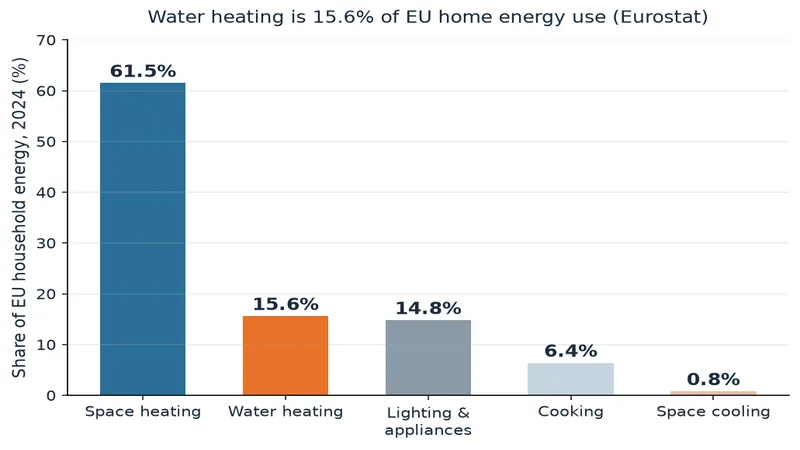
The diverter is the right first buy in three situations. First, when your hot water is currently made with electricity: households in much of southern and eastern Europe heat water with resistive elements or old boilers, and water heating is 15.6% of EU household energy use (Eurostat, June 2026). Diverting surplus into the cylinder replaces retail-priced electricity one-for-one. Second, when your water is heated by gas: a surplus kWh diverted into the cylinder displaces gas worth about 9.7 ct/kWh EU-wide (Eurostat nrg_pc_202) plus boiler losses — modest per kWh, but the hardware pays for itself in two to four years on a typical export-heavy roof. Third, when your budget is capped: €600 of diverter captures more surplus than the first €600 of battery budget, full stop. The asymmetry is deliberate design, not luck: a diverter earns from the first sunny Saturday, while a battery needs a designed load profile to earn its keep.
When the battery wins
The battery becomes the better answer as soon as your home runs on a heat pump. Hot water from a heat pump delivers about 3 kWh of heat per kWh of electricity, so pushing raw surplus into a resistive element is throwing away two-thirds of the value — store the electron and let the heat pump lift it later. Batteries also pay where the house has a meaningful evening load that a cylinder cannot touch, where dynamic tariffs make midnight charging profitable, and where outage protection matters — points we examined in our Dunkelflaute guide and our EU power price outlook to 2030. The tariff case keeps strengthening: Spanish households on the PVPC hourly price saw midday hours trade near zero in high-solar months, while evening hours carry the premium — exactly the shape of day a battery monetises and a cylinder cannot. And only batteries qualify for the subsidy money: in Germany a battery rides along on KfW loans, in Poland the PME 2 programme pays 30% of battery cost up to PLN 16,000, in Romania Casa Verde contributes up to RON 20,000. No diverter qualifies for any of them.
Subsidy reality check, country by country
The funding asymmetry is stark. Table 2 summarises the residential storage support our readers most often ask about, and the answer for diverters is the same everywhere: none.
Table 2 — Battery support in 2026 (diverters: not eligible in any market):
| Country | Battery support route | What it pays |
|---|---|---|
| Germany | KfW 270 (Solarstrom für Elektroautos) | Low-interest loan incl. storage |
| France | MaPrimeRénov’ | Storage only within wider renovation packages |
| Italy | Conto Termico 2.0 (GSE) | Up to 65% for heating-related works |
| Netherlands | Rijksoverheid (energie thuis) | No battery grant; net metering ends 31 Dec 2026 |
| Poland | PME 2 (przydomowemagazyny.gov.pl) | 30% of cost, PLN 16,000 cap |
| Czechia | NZÚ (zelenausporam.cz) | CZK 75,000 for PV + storage |
| Romania | Casa Verde 2026 (AFM) | Up to RON 20,000 |
| Greece | “Greece 2.0” rooftop scheme (HDB) | 45–75% of PV + storage cost |
The hybrid answer: diverter as the battery’s overflow
In practice the strongest EU setup in 2026 is not either/or — it is both, sequenced. Run the battery first: it handles the evening, the winter and the tariff game. Then let the diverter skim the overflow: midsummer days when the battery is full by 11:00 and the cylinder still has hot water to make. On such days a battery-only home exports valuable kWh at 1–8 ct; a diverter-plus-battery home banks them as heat. The pairing also extends battery life: every summer kWh routed into water is a cycle the cells do not perform, which stretches a 6,000-cycle warranty further at no cost. Installers increasingly specify the diverter upstream of the battery, and the same logic applies to other resistive loads — pool heating in Spain or Portugal, or electric underfloor slabs. The control logic matters more than the brand, and it interacts with DSO rules we covered in the zero-export guide; make sure your installer configures priority correctly under your grid connection. Whether the battery couples on the AC or DC side, as in our AC vs DC comparison, does not change the hierarchy.
The bottom line
If your cylinder is electric or gas-fired and your roof exports at French or German rates, a €600 diverter is the cheapest surplus-capture you can buy — start there. If you heat water with a heat pump, run a demanding evening household, or want the subsidy money that only storage attracts, size the battery properly and add the diverter later as overflow. Either way, stop exporting at 1.1 c€ while paying 28.32 ct. Insum Energy supplies LiFePO4 home batteries and matching inverters for exactly these hybrid setups — browse the product range, learn more about us, and contact Insum Energy for a quote sized to your roof, your cylinder and your tariff.