CE Market Surveillance for Imported Batteries: EU 2026
The CE logo on an imported home battery is the manufacturer’s own declaration — no public authority signs it. What turns that claim into something enforceable is a machine that has been rebuilt since 2021: Regulation (EU) 2019/1020 on market surveillance, a dedicated Battery Regulation with hard importer duties, a new General Product Safety Regulation for online sales, and customs and Safety Gate databases that connect a flagged battery in one member state to delisting across all 27. For EU buyers, installers and distributors of imported LiFePO4 storage, the question is who answers when an authority knocks — and what to check before the box is opened.
What the CE Mark on a Battery Actually Claims
Since 18 August 2024, every battery placed on the EU market must conform to Regulation (EU) 2023/1542. For most home-storage packs the conformity assessment is Module A — internal production control run by the manufacturer itself — under Article 17 and Annex VIII. The manufacturer draws up the EU declaration of conformity, affixes the CE mark and keeps the technical file. Article 12 and Annex V add safety requirements for fixed battery energy storage systems, and Article 14 obliges a BMS that can report battery health and expected lifetime. Every element of that stack is self-declared — which is exactly why the surveillance side matters: since 2021, a regulation exists whose only job is to test the claim.
The Enforcement Machine: Regulation (EU) 2019/1020
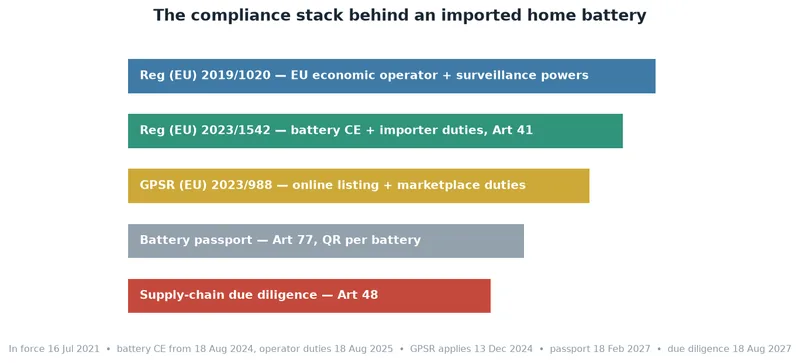
Regulation (EU) 2019/1020, applicable since 16 July 2021, sets one gate at the entrance of the single market: a product covered by EU harmonisation law may not be placed on the market unless an economic operator established in the Union takes responsibility for it — the manufacturer, the importer, an authorised representative under written mandate, or, failing all of those, a fulfilment service provider (Commission Article 4 guidelines). That operator must keep the declaration of conformity and technical documentation at the authorities’ disposal, hand over documents on a reasoned request, inform authorities when a product presents a risk, and cooperate in corrective action. Its name and postal address must appear on the product, the packaging, the parcel or an accompanying document. “Established” means a real presence — not a mailbox.
The powers behind the gate are concrete: unannounced inspections, product sampling, orders to withdraw or recall, and — for serious risks — website takedown orders. Member states may reclaim enforcement costs from the operator and must maintain dissuasive penalties and a four-yearly surveillance strategy.
Importer Duties Under the Battery Regulation
For batteries specifically, Article 41 of Regulation (EU) 2023/1542 makes importers a second line of defence. Before placing a battery on the market, an importer must verify that the declaration of conformity and technical documentation have been drawn up, that the conformity assessment was carried out, that the battery bears the CE mark and the required Article 13 labelling, and that instructions are in the end-user’s language. The importer must put its own name and postal address on the battery, run sample testing where risks warrant it, and keep a register of complaints and recalls. The economic-operator chapter has applied since 18 August 2025.
Two later milestones matter for buyers planning 2026–2027 purchases: supply-chain due diligence under Article 48 now applies from 18 August 2027, postponed by Regulation (EU) 2025/1561, and the QR-coded battery passport arrives on 18 February 2027. A battery that skips any of this is not “CE certified” — it is unlawfully placed.
GPSR Closes the Online Gap
Since 13 December 2024, the General Product Safety Regulation (EU) 2023/988 governs the channel where most grey imports flow. Article 19 requires every online listing to show the manufacturer’s name and address, the EU responsible person where the manufacturer is outside the Union, a product image and the safety warnings — before purchase, not in the box. Article 22 obliges marketplaces to support recalls and suspend repeat-offending traders. Where no sectoral law applies, Article 16 extends the responsible-operator logic to all consumer products. Penalties under Article 44 are set nationally and must be effective, proportionate and dissuasive — several member states cap the gravest cases at around 4% of annual turnover.
The Numbers Behind the Logo
Enforcement is no longer theoretical. In 2024 the EU’s Safety Gate rapid alert system logged 4,137 alerts — the highest since the system launched in 2003 — and national authorities took over 4,200 follow-up actions to stop or reverse sales; electrical appliances were the third-most-flagged category at 10%, behind cosmetics (36%) and toys (15%) (European Commission, Safety Gate 2024 annual report).
Customs enforcement points the same way: in 2023 authorities detained around 152 million counterfeit articles worth an estimated €3.4 billion — up 77% in volume and 68% in value on 2022 (European Commission & EUIPO, IPR enforcement report 2023). Cheap, mislabelled cells and power electronics move through these channels.
The volume driver is e-commerce: around 4.6 billion consignments under €150 entered the EU in 2024 — 12 million parcels a day, twice the 2023 count, 91% shipped from China (European Commission, E-commerce Communication, 5 February 2025). The Commission’s toolbox answers with coordinated customs controls, a proposed removal of the €150 duty exemption and closer joint checks between customs and surveillance staff. A single €3,000 battery can hide in this stream — undervalued, unregistered, untraceable.
What Happens When a Battery Is Flagged
The sequence is fast and cumulative. An authority samples a pack and finds non-conformity — missing technical file, unsafe cell, false CE — and orders corrective action. If the risk is serious, the product is withdrawn or recalled and the alert enters Safety Gate, where every other member state can act on the same listing. Marketplaces delist, customs can suspend identical consignments, and the economic operator — usually the importer — pays for the recall. For an installer the damage is reputational and financial: a fire after a non-compliant grey import is exactly where insurers interrogate the paper trail (insurance and certification guide).
The Paper Check Before You Buy
- Declaration of conformity: a signed EU DoC naming the exact battery model and listing Regulation (EU) 2023/1542 plus the Low Voltage and EMC Directives where relevant.
- EU operator on the label: an importer’s or authorised representative’s name and postal address on the battery, packaging or documents — not just a reseller’s email.
- Technical file on request: Annex V safety parameters for the fixed storage system, BMS data capability, and cell-level test evidence such as IEC/EN 62619 and UN 38.3 transport certification.
- Red flags: direct drop-shipping with no EU-established operator, a “CE” that resembles the China Export mark, prices far below market with no back-to-back warranty — the supply chain behind such offers is what the due-diligence buyer’s guide unpacks.
None of this is paperwork for its own sake: the regime works because documents exist that an authority can demand within days — and because the 2027 passport makes each battery’s identity machine-readable (Battery Regulation overview).
What Compliant Hardware Costs — and What Subsidies Offset
A certified 10 kWh LiFePO4 home system installed typically runs €4,800–8,800 depending on AC- or DC-coupling and labour rates (AC vs DC coupling guide). Compliance is largely priced in; subsidies close the gap faster than grey imports ever will — with EU household electricity averaging €0.2832/kWh in the first half of 2026 (Eurostat nrg_pc_204), certified storage out-earns uncertified savings. The 2026 support landscape:
| Country | Programme | What it pays (2026) |
|---|---|---|
| Germany | KfW 270 (442 closed) | Low-interest loans for solar + storage via partner banks |
| France | MaPrimeRénov’ 2026 | Heat-pump tiers €5,000/€4,000/€3,000 via ANAH |
| Italy | Conto Termico 2.0 | Up to 65% deduction, €900m/year envelope |
| Netherlands | Salderingsregeling ends 31 Dec 2026 | Final full net-metering year — storage gains value in 2027 |
| Poland | Mój Prąd (PME 2) | 30% of storage cost, up to PLN 16,000 (~€3,700) |
| Czechia | NZÚ storage call | Up to CZK 75,000 (~€3,000) — call currently paused |
| Romania | Casa Verde 2026 | Up to RON 20,000 (~€4,000) for PV + storage |
| Greece | National PV + storage programme | 45–75% subsidy by region |
Sources: KfW, ANAH, GSE, Rijksoverheid, przydomowemagazyny.gov.pl, zelenausporam.cz, AFM, HDB. Financing structures are compared in the financing and leasing guide.
The Bottom Line
The CE mark is a starting claim, not a certification. Since 2021 the EU has built the machinery to test that claim — a mandatory EU-established operator, importer verification duties, marketplace accountability, customs checks and a record-speed alert system — and 2024–2025 statistics show it in use. Buyers and installers need only two questions: who is the responsible operator established in the Union, and can they produce the conformity file within days? If either answer is vague, the cheap battery is expensive.
Buying or specifying imported storage? Contact Insum Energy for fully documented, EU-compliant LiFePO4 systems — every unit ships with declaration of conformity, technical file and importer labelling as standard. Learn more about us, browse the product range or start from the homepage. Import cost planning is covered in the CBAM buyer’s guide.