
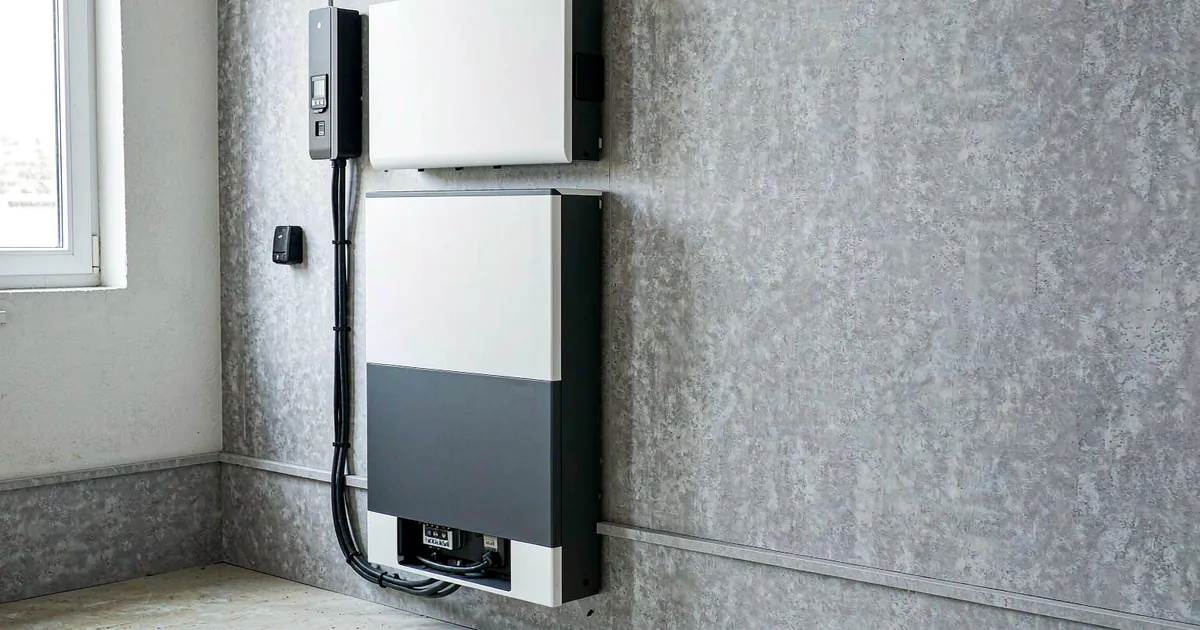
Battery Storage Grid-Fee Avoidance in Germany & the EU 2026
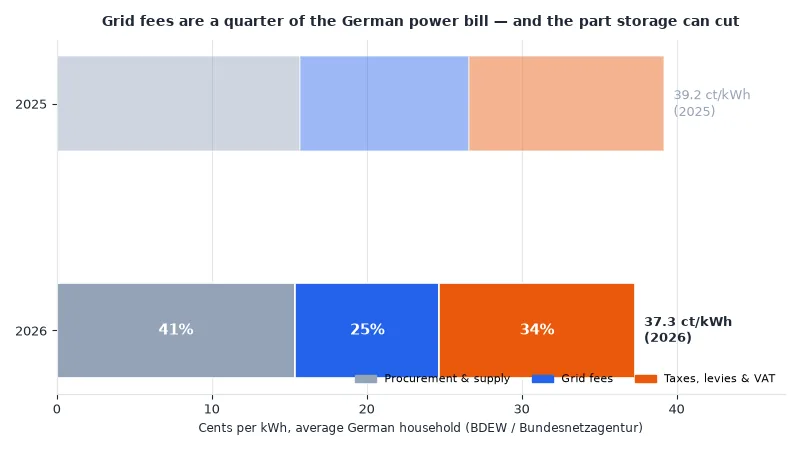
An electricity bill in the EU in 2026 is no longer dominated by the energy itself. The average German household pays 37.0 ct/kWh (BDEW, April 2026): 9.3 ct/kWh — roughly a quarter — goes to grid fees, 12.6 ct/kWh to taxes and levies, and only about 15 ct/kWh to procurement. Grid fees are regulated, identical for every supplier in your area, and increasingly designed to reward customers who shift and store load — revenue that requires no export at all. This guide from Insum Energy covers Germany’s grid-fee regime in 2026, the most developed in the EU, and how the Netherlands, Belgium, Austria and Spain compare.
Why grid fees became the lever of the battery decade
EU law now treats storage as a grid asset. Regulation (EU) 2019/943, Article 18(1) requires that network charges “shall not discriminate either positively or negatively against energy storage or aggregation”, and Article 18(7) allows distribution tariffs to include connection-capacity elements and time-differentiated rates once smart meters are deployed. Directive (EU) 2019/944, Article 15(5)(b) goes further: active customers who own storage must not face double charges, including network charges, for stored electricity remaining on their premises or when providing flexibility services. The 2024 market-design revision — Regulation (EU) 2024/1747 and Directive (EU) 2024/1711 — pushed member states to implement such tariffs rather than merely permit them.
Three mechanisms decide what a battery saves: a §14a consumption discount, a §118(6) exemption for stored electricity, and capacity-based or time-of-use network tariffs (Belgium, Austria, the Netherlands).
Germany: §14a EnWG turns a heat pump and a battery into a tariff discount
Since 1 January 2024, German grid operators must offer reduced grid fees to controllable consumption devices above 4.2 kW — heat pumps, wallboxes and, increasingly, home batteries. In exchange the DSO may dim the device to 4.2 kW for up to two hours a day. Self-generated solar is never counted against that limit, the discount applies to the network charge rather than the supplier’s energy price, and pre-2024 registrations keep their old rules until 31 December 2028.
The three modules compared
| §14a module | How the discount works | Best suited to | Typical gain (2026) |
|---|---|---|---|
| Module 1 (default) | Flat annual credit per metering point: €80 + 3,750 kWh × low-voltage energy charge × 0.2. No extra meter needed. | Batteries that rarely charge from the grid | €110–€190 per year (Bundesnetzagentur range) |
| Module 2 | Grid working price cut by 60% — you pay 40% — with no base price at that metering point. Separate meter required. | Heat pumps, wallboxes and storage with steady grid draw | Break-even with Module 1 at ~2,900 kWh/yr; ≈€240/yr at 5,000 kWh and 8 ct/kWh |
| Module 3 | Time-variable grid fees in three bands; the low band is 10–40% of the standard rate. Needs an iMSys smart meter; combined with Module 1. | Systems with an EMS that schedules charging into cheap windows | Up to 60% of the grid fee on shifted consumption |
Module 3 is the option built for batteries: it turns flexible load into a fee arbitrage between the afternoon and the evening peak. Combining its low-tariff windows with an hourly wholesale price signal is where the real optimisation happens — see our guide to dynamic electricity tariffs and LiFePO4 charging strategies.
§118(6) EnWG: the storage exemption that expires in 2029
Separate from §14a, and often confused with it, §118(6) EnWG exempts electricity storage from grid fees on the electricity it draws for storage for 20 years from commissioning — provided the system is commissioned by 4 August 2029 and the energy is fed back into the same grid. It covers grid fees in the narrow sense (the active and reactive working price), but not the concession levy, metering or statutory surcharges.
What changed in 2026
2026 has been the year of clarification. After signalling in January that it might extend fees to existing storage, the Bundesnetzagentur confirmed on 27 May 2026 that operating projects — and projects with a final investment decision before the new AgNes framework enters into force in late 2026 or early 2027, commissioned by 4 August 2029 — keep the 20-year exemption. For everything else the proposed model is a single capacity-based charge of roughly €4–7/kW per year, with no double charging on charge and discharge and no storage fee at all for home systems below 30 kW. Grid connection for storage still carries a construction-cost contribution (BGH, EnVR 1/24), and §11c EnWG now treats storage as being in the overriding public interest.
For commercial sites the sums are material: a 400 kWh system shifting 500 MWh a year can avoid up to €0.08/kWh of low-voltage grid fees — tens of thousands of euros annually — before a single kWh is traded. Whether those rules apply to you depends on the behind-the-meter versus front-of-the-meter question set out in BTM vs FTM battery storage in the EU.
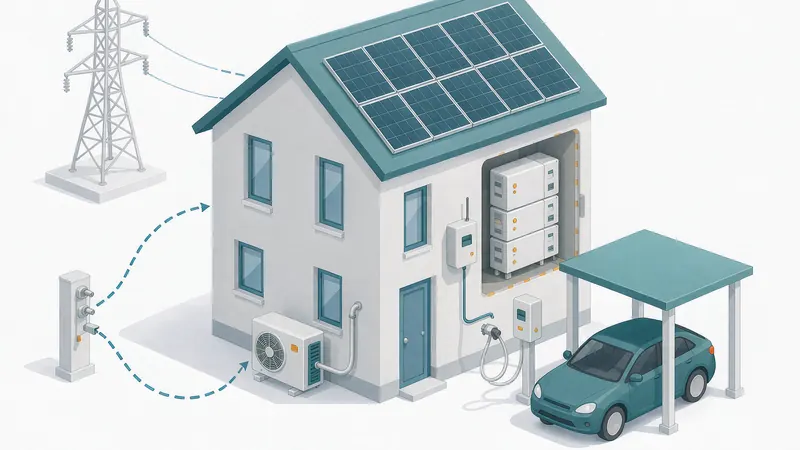
How the rest of the EU compares in 2026
| Country | Grid-fee mechanism for storage | What it means in 2026 |
|---|---|---|
| Germany | §14a EnWG discounts, §118(6) exemption for stored electricity, planned AgNes capacity fee of €4–7/kW/yr | Home storage is fee-exempt below 30 kW and can claim Module 1–3; commercial projects need commissioning by 4 August 2029 to lock the exemption |
| Netherlands | Salderingsregeling ends 1 January 2027; thereafter suppliers pay at least 50% of the bare supply tariff and feed-in costs may only reflect actual costs; network tariffs keep rising | No national home-battery grant, so self-consumption plus Flex-e funded flexibility carries the case — see our net metering phase-out guide |
| Belgium | Flanders’ capaciteitstarief charges about €50–80 per kW of monthly peak; Wallonia’s CWaPE five-slot time-of-use tariff started in January 2026 | Shaving 2–3 kW of peak is worth €100–250 a year, reinforced by 6% VAT — compare Belgium, Austria and Switzerland |
| Austria | The new ElWG defines storage as a market participant with a 20-year exemption from grid-usage and grid-loss charges for “system-beneficial” standalone storage; E-Control’s SNE-G-V applies from 1 January 2027 | Standalone storage above 1 MW at congested nodes with a flexibility contract can be fully exempt; behind-the-meter systems rely on time-variable and load-variable reductions |
| Spain | Storage is assessed twice, as generation and as demand, so guarantees can reach €60,000/MW; RDL 7/2026 added flexible access permits and a 10–20% income-tax deduction for self-consumption | With PVPC averaging €0.11–0.13/kWh the value sits in self-consumption and the deduction, not in fee avoidance — see our Iberian storage guide |
| Italy, Poland, Czechia, Romania, Greece | Grid fees remain largely flat and volume-based, so grants do the work: Conto Termico 2.0, Mój Prąd 2026, NZÚ, Casa Verde 2026 and the Greek storage programmes | Stack the grant with a time-of-use tariff: on a flat network tariff a battery earns from price spread, not from fees |
What it is worth in euro: two worked examples
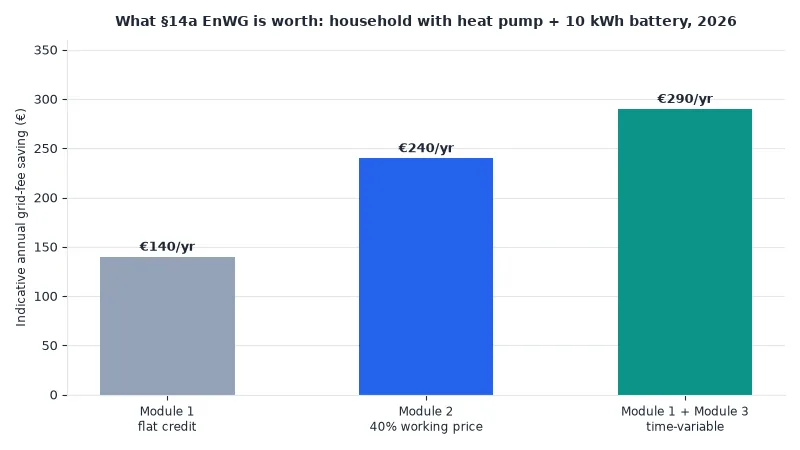
A German single-family home with a heat pump and an 8–10 kWh LiFePO4 battery is the classic case. If the heat pump draws 5,000 kWh a year from the grid at a low-voltage working price of 8 ct/kWh, Module 2 saves 0.6 × 5,000 × €0.08 ≈ €240 a year before the cost of a second meter, against roughly €140 from Module 1. Because a second metering point carries its own annual fee, Module 1 usually wins where the meter cabinet would need rebuilding.
The commercial picture is larger. Registered as a controllable consumption device, the same battery can be dimmed to 4.2 kW during network stress — a limit the EMS must honour above any market signal — while §118(6) removes grid fees entirely on stored volumes. That is why German BESS developers are racing the August 2029 deadline.
How to claim grid-fee relief: a practical checklist
- Notify the DSO before commissioning a controllable device (§19(2) NAV); registration is a precondition for any §14a module.
- Meter it correctly: Module 1 needs no second meter, Module 2 does, Module 3 requires a smart meter gateway.
- Lock the exemption early: commission commercial storage by 4 August 2029 and document the final investment decision — binding procurement covering about half the investment volume plus a binding grid connection commitment.
- Programme the EMS for the fee bands, not just the spot price; §14a dimming signals always override market dispatch.
- Stack the grants: German 0% VAT and KfW 270 financing, France’s MaPrimeRénov’ 2026 package of up to about €11,000 for renovation including storage, Italy’s Conto Termico 2.0 plus a 50% deduction, Poland’s Mój Prąd 2026 (≈€1,700–€3,500), Czechia’s NZÚ (≈€6,000), Romania’s Casa Verde 2026 and the Greek storage programmes all change the net cost.
Get a battery sized for the tariff, not just the roof
Grid-fee relief rewards systems that can be controlled, metered and documented: a battery with a responsive EMS and paperwork that satisfies both the DSO and the grant authority. Insum Energy supplies EU-market LiFePO4 battery systems from 5 kWh cabinets to 400 kWh commercial racks, with documentation aligned to EU regulations and national subsidy files. Browse the battery storage product range, read more about Insum Energy, or contact our team for a tariff-aware quote.


One Comment