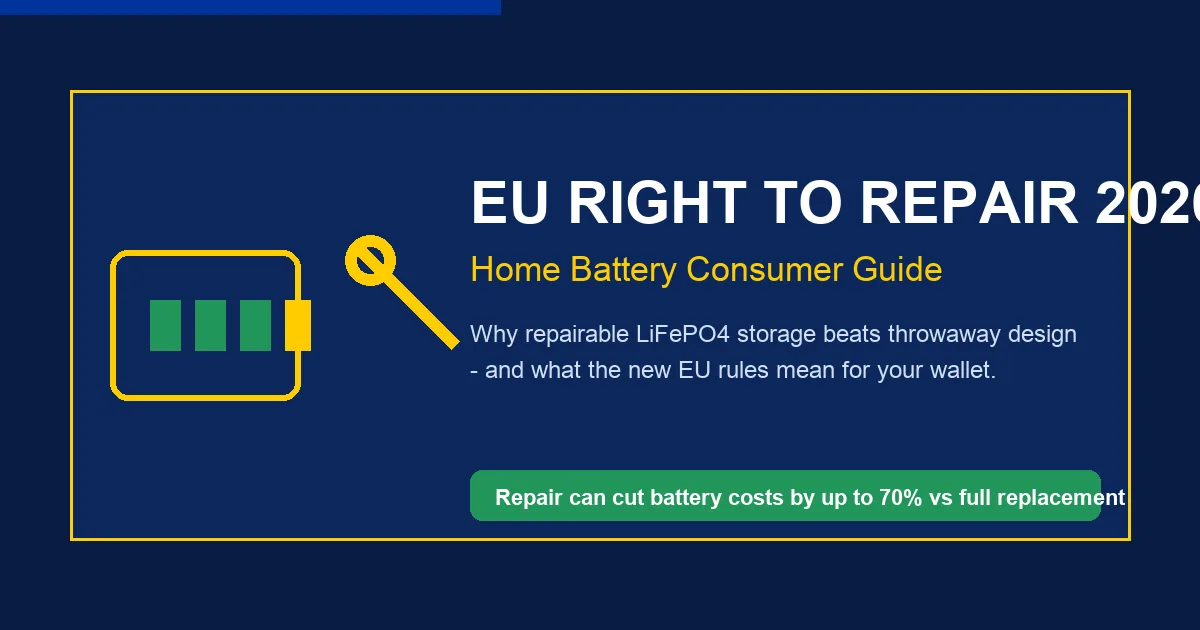
Right to Repair Home Batteries: EU 2026 Consumer Guide
This guide from Insum Energy explains how the EU’s right-to-repair agenda is reshaping home battery storage. Most home batteries are sold as sealed black boxes. When one cell drifts or the battery management system (BMS) fails, many owners are told to scrap the whole unit and buy a new one – often for €4,500 to €9,000. The European Union is changing that equation. A wave of right-to-repair rules arriving through 2026 makes repairable, modular design the smart choice for EU households, installers and distributors alike. This guide explains the regulations, the euro math, and exactly what to check before you buy.
Why Right to Repair Matters for Home Battery Owners
A LiFePO4 home battery is a long-life asset. With proper care it should deliver 6,000+ cycles – easily 10 to 15 years of service. Yet a single failed BMS board or one weak cell should not condemn a €6,000 pack to landfill. Repair keeps your self-consumption savings flowing against high EU retail prices: German households still pay roughly €0.35–€0.45/kWh, Spanish PVPC users see volatile hourly rates around €0.10–€0.25/kWh, and Dutch dynamic “S++” tariffs hover near €0.25–€0.35/kWh in 2026. Every year you avoid a premature replacement is a year of free stored solar.
If you are comparing systems, start with our home battery product range and pair it with the practical checks below.
The EU Legal Framework: Three Pillars
Three EU instruments now shape repairability for stationary storage. None of them are optional for suppliers selling into the EU market.
1. Regulation (EU) 2023/1542 – the Batteries Regulation
In force since 2023 and phasing in through 2025–2027, the Batteries Regulation is the most direct rule for our industry. It requires batteries to be designed so that spare parts are available and repair and maintenance information is provided for a defined period. For stationary and industrial batteries this pushes manufacturers toward modular packs with replaceable cells and serviceable BMS modules rather than glued, unserviceable blocks. It also links repair to the broader EU carbon footprint declaration logic: keeping a battery in service is the lowest-carbon option.
2. Directive (EU) 2024/1799 – the Right to Repair Directive
Adopted in June 2024, Member States must transpose this Directive into national law by 31 July 2026. It gives consumers a right to an affordable repair once the legal guarantee has expired, creates a standard European repair information form, and tells manufacturers to repair rather than replace where technically feasible. Home batteries are not in the very first product Annex, but the Directive’s principles – and subsequent delegated acts – are already steering the market toward repair-friendly design, and it strengthens the position of independent repair shops.
3. Regulation (EU) 2024/1781 – the Ecodesign for Sustainable Products Regulation (ESPR)
The ESPR, in force since mid-2024, replaces the old Ecodesign Directive and lets the Commission set future repairability and spare-parts requirements for almost any product, including energy storage. Expect delegated acts over 2026–2028 that make “designed for repair” a formal compliance criterion.
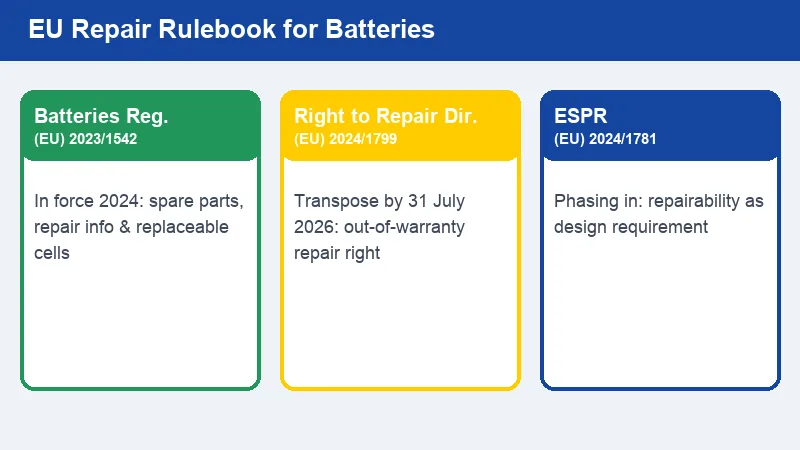
| Instrument | Number | Status in 2026 | Relevance to home batteries |
|---|---|---|---|
| Batteries Regulation | (EU) 2023/1542 | In force, phasing in | Spare parts, repair info, replaceable cells |
| Right to Repair Directive | (EU) 2024/1799 | Transpose by 31 Jul 2026 | Out-of-warranty repair right, repair form |
| ESPR | (EU) 2024/1781 | Phasing in | Future repairability ecodesign rules |
What “Repairable” Looks Like in a LiFePO4 Pack
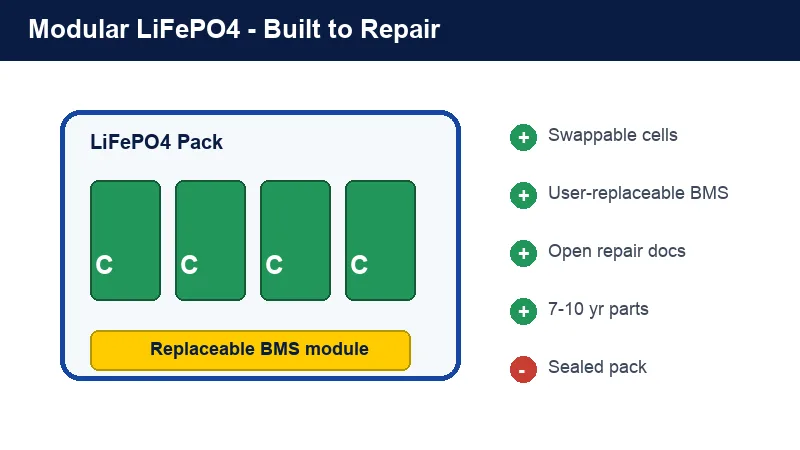
Not every battery marketed as “repairable” actually is. Look for four concrete traits:
- Swappable cells. Individual LiFePO4 cells or modules should be accessible without destroying the enclosure.
- User- or installer-replaceable BMS. A failed BMS should be a €80–€250 part, not a reason to bin the pack.
- Open repair documentation. Wiring diagrams, error codes and torque specs should be published, not locked behind a service contract.
- 7–10 year parts availability. The supplier must commit to stocking cells and BMS for the battery’s realistic service life.
These traits also protect your warranty position. See our home battery warranty guide for EU consumers for the fine print on what warranties do – and do not – cover.
Repair vs Replace: The Euro Math
For a typical 10 kWh residential LiFePO4 system, the numbers are stark:
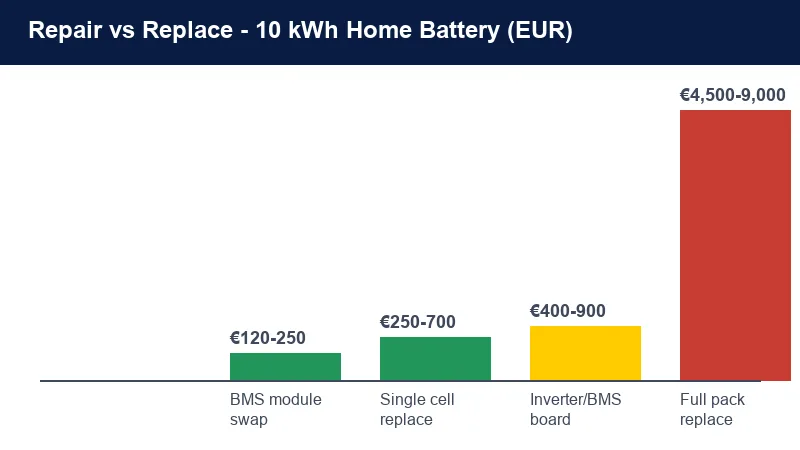
| Option | Typical cost (EUR) | Keeps subsidy? | CO2 impact |
|---|---|---|---|
| BMS module swap | €120–€450 | Yes | Very low |
| Single cell / module replace | €250–€900 | Yes | Low |
| Full pack replacement | €4,500–€9,000 | Often restarts clock | High |
In most cases a targeted repair saves 60–80% versus ripping out the whole battery. That margin is exactly why managing LiFePO4 degradation through timely cell balancing and BMS care pays off.
National Repair Incentives Across the EU
Beyond the EU framework, several member states already reward repair:
- Germany: The federal Reparaturbonus (repair bonus) refunds a share of repair costs – typically up to 50%, capped around €100–€200 per item – on top of any KfW storage support.
- France: The AGEC anti-waste law funds a fonds de réparation contributing up to €25 per repaired item, alongside the evolving repairability index.
- Netherlands, Italy, Poland, Czechia, Romania & Greece: National schemes such as KfW (DE), MaPrimeRénov’ 2026 (FR), Conto Termico 2.0 (IT), the Salderingsregeling/ODE (NL), Mój Prąd 2026 (PL), NZÚ (CZ), Casa Verde 2026 (RO) and Greek storage grants all assume a multi-year asset – a repairable battery protects that public investment.
How Repair Protects Your Subsidy Investment
When a battery is co-financed through KfW, MaPrimeRénov’ or a national grant, scrapping it early wastes public money and your co-payment. A repairable design means a €200 BMS fix preserves a €6,000 subsidised asset instead of triggering a brand-new purchase (and a fresh subsidy application). It also keeps you aligned with battery recycling and second-life obligations by delaying end-of-life processing.
And don’t forget compliance: repaired packs must still meet EU insurance and certification requirements (EN 62619, IEC 63056) – so use certified parts and qualified installers.
A Consumer Checklist Before You Buy
- Ask the vendor: “Can the BMS and individual cells be replaced separately?”
- Confirm a published spare-parts price list and a 7–10 year availability commitment.
- Check that repair documentation (schematics, error codes) is freely provided.
- Verify the pack carries EN 62619 / IEC 63056 and CE marking.
- Confirm your national repair bonus or subsidy applies to repairs, not just new builds.
- Choose an installer who offers post-warranty repair, not just replacement quotes.
Conclusion
The EU’s right-to-repair agenda turns battery repair from a niche favour into a legal expectation. For homeowners the prize is years of extra service and thousands of euros saved; for installers and distributors, repairable modular systems are becoming the only compliant way to sell. Choose designs built to be opened, not buried.
Ready to spec a repairable home battery? Contact Insum Energy for a tailored quote and EU-compliance advice, or learn more about our team. Explore our full product line-up today.