
EU Battery Passport 2027: What Home Battery Owners Must Prepare
From February 2027, the European Union will require every new battery sold within its borders — including home energy storage systems — to carry a Digital Battery Passport. If you are a homeowner, installer, or business investing in LiFePO4 battery storage, this regulation will directly affect your purchasing decisions, warranty coverage, and long-term planning.
This guide explains exactly what the EU Battery Passport is, which data it must contain, how to check if your battery is compliant, and what steps you should take today to stay ahead of the 2027 deadline.
What Is the EU Battery Passport?
The EU Battery Passport is a digital record attached to every battery, accessible via a QR code printed on the battery casing. Think of it as a vehicle registration document — but for your battery. It contains technical specifications, sustainability data, supply chain history, and performance records that regulators, recyclers, and consumers can all verify.
The requirement comes from EU Regulation (EU) 2023/1542, which overhauled the previous 2006 Battery Directive. Unlike the old framework, the new regulation is explicitly designed for the era of electric vehicles, renewable energy storage, and circular economy goals.
Why Is the EU Introducing Battery Passports?
The EU has three core objectives with this regulation:
- Transparency: Make supply chains visible — especially for critical raw materials like lithium, cobalt, and nickel, which are often sourced from regions with poor labour or environmental standards.
- Sustainability accountability: Force manufacturers to declare and eventually reduce the carbon footprint of every battery throughout its lifecycle.
- Circular economy: Ensure batteries are designed for longevity, repairability, and responsible recycling rather than landfill disposal.
For home battery owners, this means that from 2027 onward, you will be entitled to see exactly where your battery cells came from, how much carbon was emitted in their production, and what their expected lifespan looks like.
Implementation Timeline: Key Dates to Know
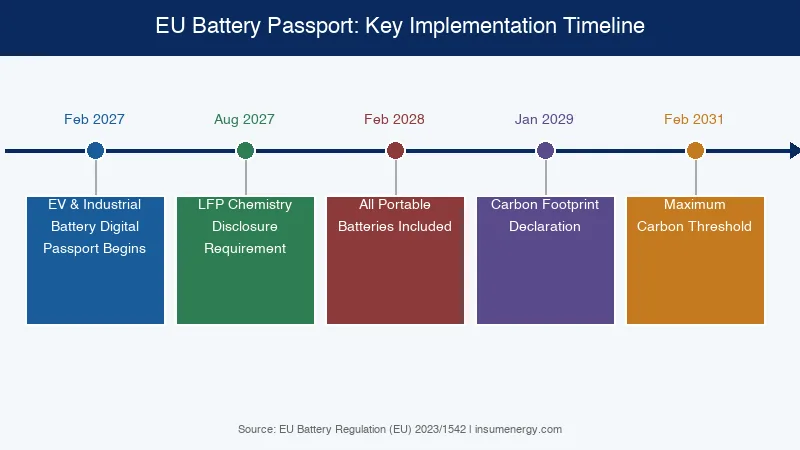
- February 2027: EV batteries and industrial batteries over 2 kWh must carry a digital passport.
- August 2027: Chemistry disclosure requirements extended to all chemistries including LFP (Lithium Iron Phosphate).
- February 2028: Portable batteries (including smaller home storage units) included in the scheme.
- January 2029: Manufacturers must declare the carbon footprint of EV and industrial batteries.
- February 2031: Maximum carbon footprint thresholds become mandatory — batteries exceeding the limit cannot be sold in the EU.
If you are buying a home energy storage system now, it will not yet fall under mandatory passport rules — but this changes for systems purchased after February 2028.
What Data Does the Battery Passport Contain?
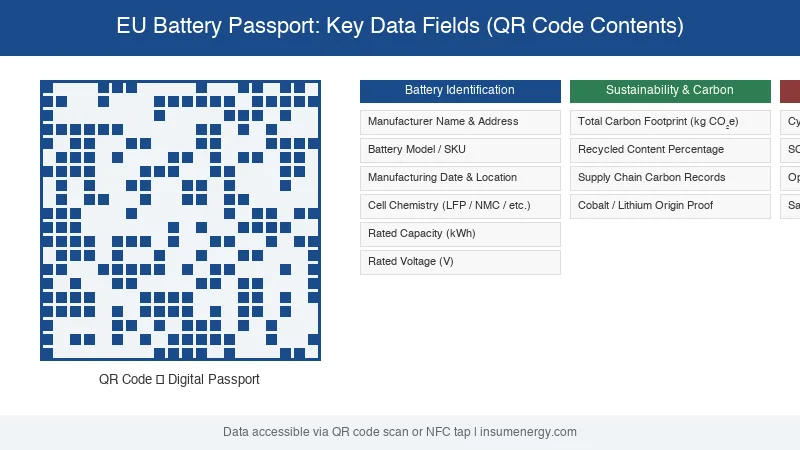
The passport is not just a product label. It is a living digital document that can be updated throughout the battery’s life. Here is what it must include:
1. Battery Identification
- Manufacturer name and registered address
- Battery model, SKU, and serial number
- Manufacturing date and production facility location
- Cell chemistry (LFP, NMC, etc.)
- Rated capacity (kWh) and nominal voltage
2. Carbon Footprint and Sustainability
- Total lifecycle carbon footprint in kg CO2 equivalent
- Percentage of recycled content (both pre-consumer and post-consumer)
- Proof of origin for critical raw materials (cobalt, lithium, nickel)
- Documentation of responsible sourcing schemes used
3. Performance and Safety Records
- Rated cycle life at 80% depth of discharge
- State of Health (SOH) records — updated throughout the battery’s life
- Operating temperature range and thermal management specifications
- Safety certifications (CE marking, UL listings)
4. End-of-Life and Second-Life Information
- Recyclability percentage and applicable recycling processes
- Authorised waste collection and recycling schemes
- Second-life eligibility status (can the battery be repurposed after its primary use?)
- Upcoming regulatory carbon thresholds
Why This Matters for Home Battery Buyers
If you are planning to install a home battery system, the EU Battery Passport will give you a powerful new tool for making informed decisions. Here is how:
Compare Apples to Apples
Before this regulation, comparing battery brands on sustainability was largely guesswork. Now, every battery will carry its carbon footprint declaration — allowing you to choose products aligned with your environmental values.
Verify Brand Claims
Some manufacturers claim their batteries are “grade A” cells or have “6,000+ cycles.” The passport provides verifiable documentation — no more relying solely on marketing materials.
Protect Your Investment
A battery with poor SOH tracking or undisclosed recycled content may deteriorate faster than expected. The mandatory performance and health tracking in the passport gives you recourse if a product underperforms its specifications.
Resale and Second-Life Value
As the second-life battery market grows — used home batteries repurposed for camping, off-grid cabins, or backup systems — having a verifiable passport will become a significant value driver. A battery with a complete, clean passport will be worth more than one without.
How to Check a Battery Passport
When purchasing a new home battery system in or for delivery to the EU after February 2028, ask the manufacturer or installer for the battery passport QR code. Scan it with any smartphone to access:
- The battery’s unique digital twin record
- All current performance and health data
- Carbon footprint and recycled content declarations
- Supply chain and materials sourcing information
Third-party platforms such as Circulor, GoodGuide, and the EU’s own Battery Passport Platform are already being integrated to verify passport data independently.
How Insum Energy Prepares You for the 2027 Regulation
At Insum Energy, we are actively tracking all EU Battery Regulation developments and working with our cell suppliers to ensure full compliance ahead of every mandatory deadline.
Our LiFePO4 home storage products are already documented with:
- Cell chemistry and manufacturer traceability
- Rated cycle life and capacity specifications
- Safety certifications (CE and relevant UL standards)
- Recycled content documentation from Tier-1 suppliers
We are preparing our digital passport infrastructure so that every Insum Energy battery shipped to the EU market from 2027 onwards will carry a fully compliant, QR-code-accessible passport.
Action Checklist for Homeowners and Installers
- ✅ If buying now: Request full technical documentation and cell traceability from your supplier — this will become mandatory anyway.
- ✅ If buying after Feb 2028: Insist on a QR-code battery passport before purchase. Refuse to buy systems without one.
- ✅ If installing in the EU: Verify that your supplier has a compliance roadmap for EU Battery Regulation 2023/1542.
- ✅ Track carbon thresholds: By 2031, batteries exceeding the EU’s maximum carbon limit will be banned from sale. Factor this into long-term investment decisions.
- ✅ Preserve your passport: Keep a record of your battery’s QR code and passport data — it will matter for resale, warranty claims, and recycling.
Conclusion: The Passport Is Your Protection
The EU Battery Passport is not just a bureaucratic requirement — it is a consumer protection mechanism that will raise the entire home battery industry to higher standards of transparency, sustainability, and accountability.
As a homeowner or business investing in energy storage, you now have the right to demand full disclosure from every battery brand. As a professional installer, you have the opportunity to position yourself as a compliance expert who helps clients navigate these new requirements.
Ready to invest in a compliant, future-proof home battery system? Contact Insum Energy today for a tailored quote and expert guidance on EU-compliant LiFePO4 energy storage solutions.
Learn more about our company and product range — or browse our full product catalogue to find the right battery for your home or business.