
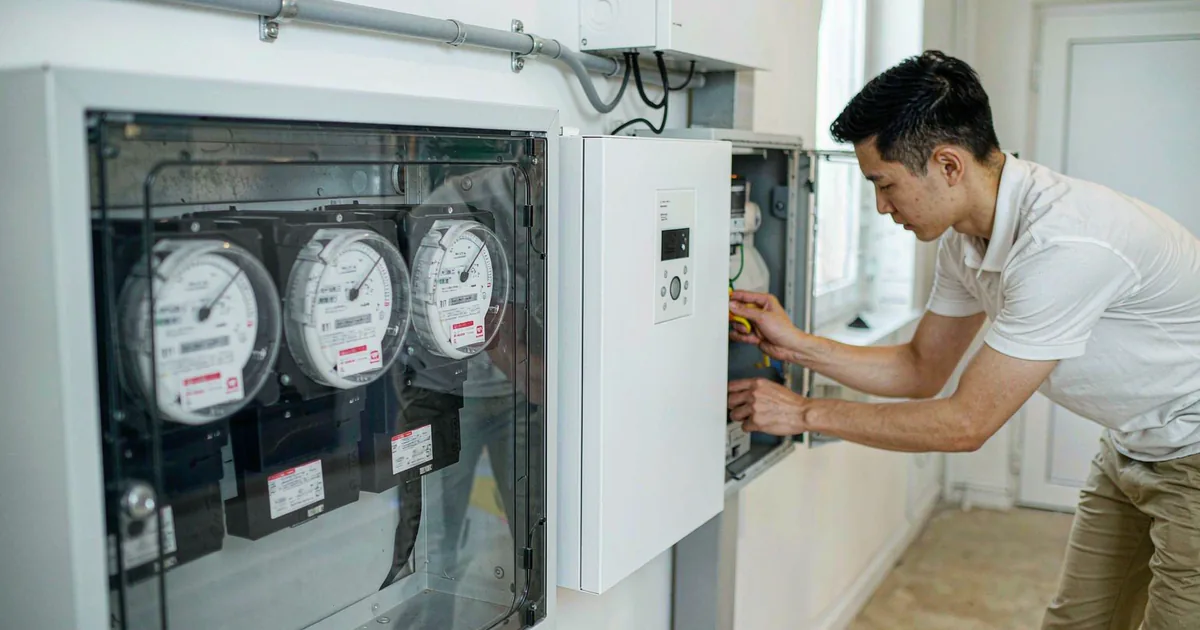
Second Meter or One? Home Storage Metering in the EU 2026
Ask an installer for a battery quote in 2026 and the answer to “do I need a second meter?” now depends on which EU country you are in, which subsidy you claim, and whether your system charges from the grid. Germany just rewrote its metering rules for storage in October. France quietly deleted the old two-meter setups. Households across the EU pay an average of €0.2832 per kWh for electricity (Eurostat, nrg_pc_204, H1 2026), so every metering choice that affects what your battery can legally store and discharge is a money question, not paperwork.
Why Metering Suddenly Matters for Storage
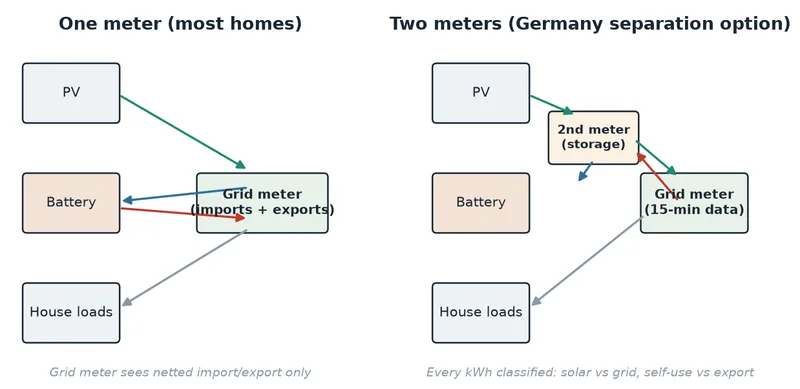
A home battery sits in the middle of four energy flows: solar production, household consumption, grid import and grid export. The utility meter only sees the last two, netted. Everything your battery does inside the house — absorbing midday solar, releasing it at 19:00 — is invisible to it. That invisibility used to be the safe default. It is no longer automatic: Regulation (EU) 2019/943 Article 8 moved EU imbalance settlement to 15-minute periods from January 2025, and Germany’s new MiSpeL framework now defines exactly how a storage system must account for every quarter-hour of mixed grid and solar charging (Regulation (EU) 2019/943, EUR-Lex).
One Meter Already Measures Most of the Story
For a standard PV-battery installation that only self-consumes, no additional meter is required anywhere in the EU. Your grid meter, increasingly a smart meter — rollout deadlines vary by country — records import and export. The inverter measures battery flows with its own current transformers or shunts for monitoring. Three cases break that simplicity:
- your battery charges from the grid (dynamic tariffs, §14a modules, VPP dispatch);
- you claim a subsidy, feed-in payment or subsidy scheme that requires certified production or discharge data;
- you share or sell energy with neighbours, tenants or an aggregator.
In those cases the question becomes legal, not electrical: which flows must a calibrated meter record, and who pays for it?
Germany: MiSpeL Ends the Two-Meter Era
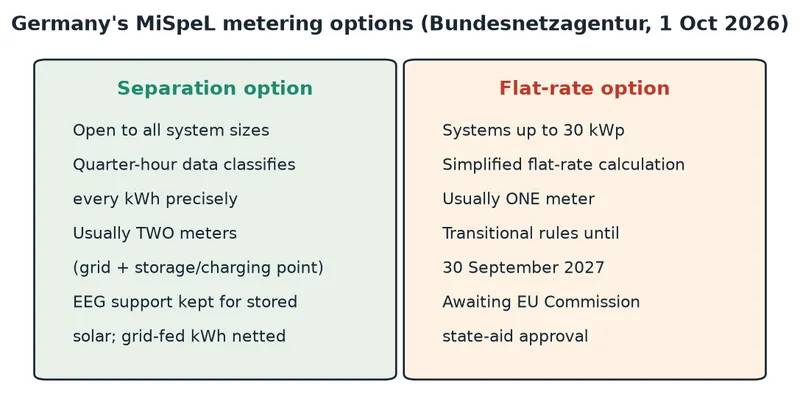
On 1 October 2026 the Bundesnetzagentur issued its MiSpeL determination on market integration of electricity storage facilities and charging points. Until then, storage had to keep solar electricity strictly separate from grid electricity; mixing cost you EEG support. MiSpeL replaces that with two accounting options (Bundesnetzagentur press release, 1 October 2026):
- Separation option — open to all systems, calculates volumes precisely from quarter-hour data. The formulas generally require two meters (grid connection plus storage/charging point), with one meter sufficient only in special cases.
- Flat-rate option — for systems up to 30 kWp, typically households. A simplified calculation that usually needs only one meter, but its application waits for European Commission state-aid approval.
The payoff justifies the meters: EEG support is preserved for temporarily stored solar electricity, and grid electricity that is later fed back is netted, reducing levies and network charges on the withdrawal — the §118(6) EnWG mechanism (§ 118(6) EnWG, gesetze-im-internet.de). Grid and metering operators have a transition period until 30 September 2027 to implement, and early application needs their agreement.
Do not confuse MiSpeL with §14a EnWG. The Module 2 grid-fee discount on a controllable device — which can be a battery above 4.2 kW — still requires a separate meter for that device, unlike the flat Module 1 (§ 14a EnWG). Whether the extra meter earns the 60% energy-charge discount is arithmetic your installer should show you; our grid-fee guide walks through the break-even near 2,900 kWh per year.
France: The Linky Already Did the Job
France is the cleanest one-meter market. For self-consumption with sale of surplus — the only route open to new residential systems since the June 2026 reform removed total sale — a single Linky meter records both your consumption and an injection index for the surplus sold under the 20-year EDF OA contract. A dedicated production meter is now largely a legacy of vente totale contracts signed before the reform; zero-injection systems settle for a simple declaration agreement (Service-Public.fr, F31487). The battery adds no meter: French surplus contracts simply require the battery to charge from solar only, never from the grid, which conveniently removes the whole accounting problem MiSpeL solves in Germany.
Spain and Italy: One Meter North, Two Meters South
Spain keeps it simple. Under Royal Decree 244/2019, self-consumers with surplus compensation of up to 100 kW settle exports against imports on the same supply meter with hourly readings — no separate production meter, no second billing point; a battery changes nothing in the metering chain (RD 244/2019, BOE).
Italy still leans the other way. Joining the GSE’s scambio sul posto exchange mechanism requires a dedicated production meter at the plant, read separately from the consumption meter, so the GSE can credit injections against withdrawals (GSE, Scambio sul Posto). Retrofitting a battery behind an existing SSE plant does not add a meter, but if you change the plant configuration you must update the GSE file — a step installers forget.
Submeters: When You Pay for the Meter Yourself
Three growing setups put the meter bill on your side of the table:
- Energy sharing and apartment buildings — allocating shared solar and storage between tenants or flats needs submeters, and any meter used to bill someone must comply with the MID measuring-instruments Directive (Directive 2014/32/EU, EUR-Lex). A €30 non-certified monitoring clamp is fine for your own app; it is not fine for a neighbour’s bill.
- VPP and aggregator revenue — when VPP programmes pay per dispatched kWh, contracts typically specify revenue-grade metering at the device or require qualified grid-meter data.
- Landlord setups — in rental situations the landlord-installed submeter must also meet country-specific rules; see our apartment and rental guide.
What a Second Meter Costs in 2026
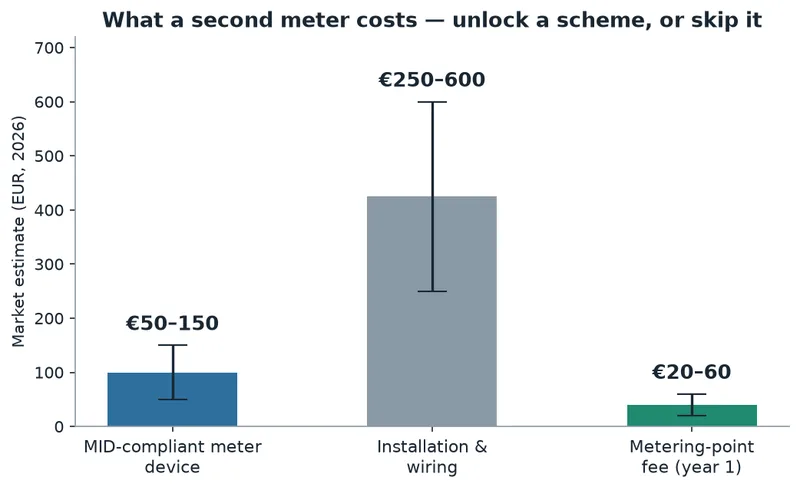
As a market estimate (prices vary by country and electrician): a MID-compliant direct meter costs €50–150, installation and wiring in the cabinet €250–600, and a metering-point operator fee, where the meter is registered, adds roughly €20–60 per year. On a 10 kWh system earning €400–900 per year from bill savings, a one-time €350–750 second-meter bill is only worth it when it unlocks a concrete scheme: the German separation option with §118(6) netting, Module 2’s 60% discount on heavy grid charging, or Italian SSE participation. If the flat-rate option’s state-aid approval lands in Germany, most households there will never need the second meter at all.
| Market | Self-consumption only | Grid charging / export revenue | Second meter needed? |
|---|---|---|---|
| Germany | No extra meter | MiSpeL separation: usually yes; flat-rate option (≤30 kWp): usually one meter | Only for separation option or §14a Module 2 |
| France | No extra meter | Single Linky injection index; battery must be solar-charged | No (legacy vente totale contracts keep their production Linky) |
| Spain | No extra meter | Same bidirectional meter settles compensation ≤100 kW | No |
| Italy | No extra meter | GSE SSE requires dedicated production meter | Yes, for SSE participants |
| Netherlands | No extra meter | Net metering (saldering) ends 1 Jan 2027; after that, hourly metering drives the bill (Rijksoverheid) | No |
| Poland, Czechia & others | No extra meter | Net-billing requires the grid meter’s hourly data | Generally no |
Storage Subsidies That Still Apply in 2026
Metering does not change what you get paid per kWh — subsidies do. The 2026 landscape, with amounts verified earlier this year:
| Country | Scheme | 2026 status |
|---|---|---|
| Germany | KfW 442 / 270 | 442 closed; 270 low-interest loans open |
| France | MaPrimeRénov’ | Heat-pump focused; batteries not covered |
| Italy | Conto Termico 2.0 | Up to 65% deduction, €900m/year |
| Netherlands | Salderingsregeling | Net metering ends 31 Dec 2026 |
| Poland | Mój Prąd / PME 2 | 30%, PLN 800/kWh, PLN 16,000 cap |
| Czechia | NZÚ (Nová zelená úsporám) | CZK 75,000 battery contribution; check pause status |
| Romania | Casa Verde | RON 20,000 cap for PV + storage |
| Greece | hdb.gr programme | 45–75% subsidy PV + battery |
How to Decide Before Your Installer Quotes
Five questions settle the metering debate in one phone call:
- Will the battery ever charge from the grid? If yes, Germany’s MiSpeL accounting applies; elsewhere check your export scheme’s rules.
- Do you keep a subsidy or feed-in contract that requires certified production or discharge data?
- Does your DSO tariff have a module or discount (like §14a Module 2) whose math needs a dedicated metering point?
- Is anyone else’s money measured by the meter — tenants, neighbours, an aggregator? Then it must be MID-compliant.
- If all four answers are no: one meter, done. Spend the €350–750 on more battery capacity instead.
Storage metering in the EU in 2026 rewards the boring answer: the meter you already own covers the vast majority of homes. The exceptions cluster where money meets the grid — and there, the meter is not a cost, it is the invoice for your revenue.
Planning a battery with grid charging, a VPP contract or a shared-roof setup? Contact Insum Energy for a metering-compliant system quote. Our LiFePO4 storage range works with single-meter and separation-option setups alike, and we ship across all 27 EU markets — or start from the Insum Energy homepage to see the full guide library.


2 Comments