
Safeguarding Your Energy: The Critical Role of BMS in LiFePO4 Battery Systems
In the world of residential energy storage, the LiFePO4 (Lithium Iron Phosphate) battery is celebrated for its inherent safety and long cycle life. However, even the most stable chemistry requires a sophisticated “brain” to ensure operational integrity. This is the role of the Battery Management System (BMS). For B2B stakeholders and DIY enthusiasts building high-capacity systems, understanding the safety layers of a BMS is not just a technical requirement—it is a safety imperative.
1. Fundamental Protection: Overcharge and Over-Discharge
The most basic yet vital function of a BMS is the enforcement of Safe Operating Area (SOA) limits.
- Overcharge Protection (OVP): If a single cell exceeds its voltage limit (typically 3.65V for LFP), the BMS disconnects the charger to prevent electrolyte decomposition and potential swelling.
- Over-Discharge Protection (UVP): Conversely, if a cell drops below a critical threshold (e.g., 2.5V), the BMS shuts down the load to prevent irreversible chemical damage that would permanently kill the battery’s capacity.
2. The Science of Balance: Active vs. Passive
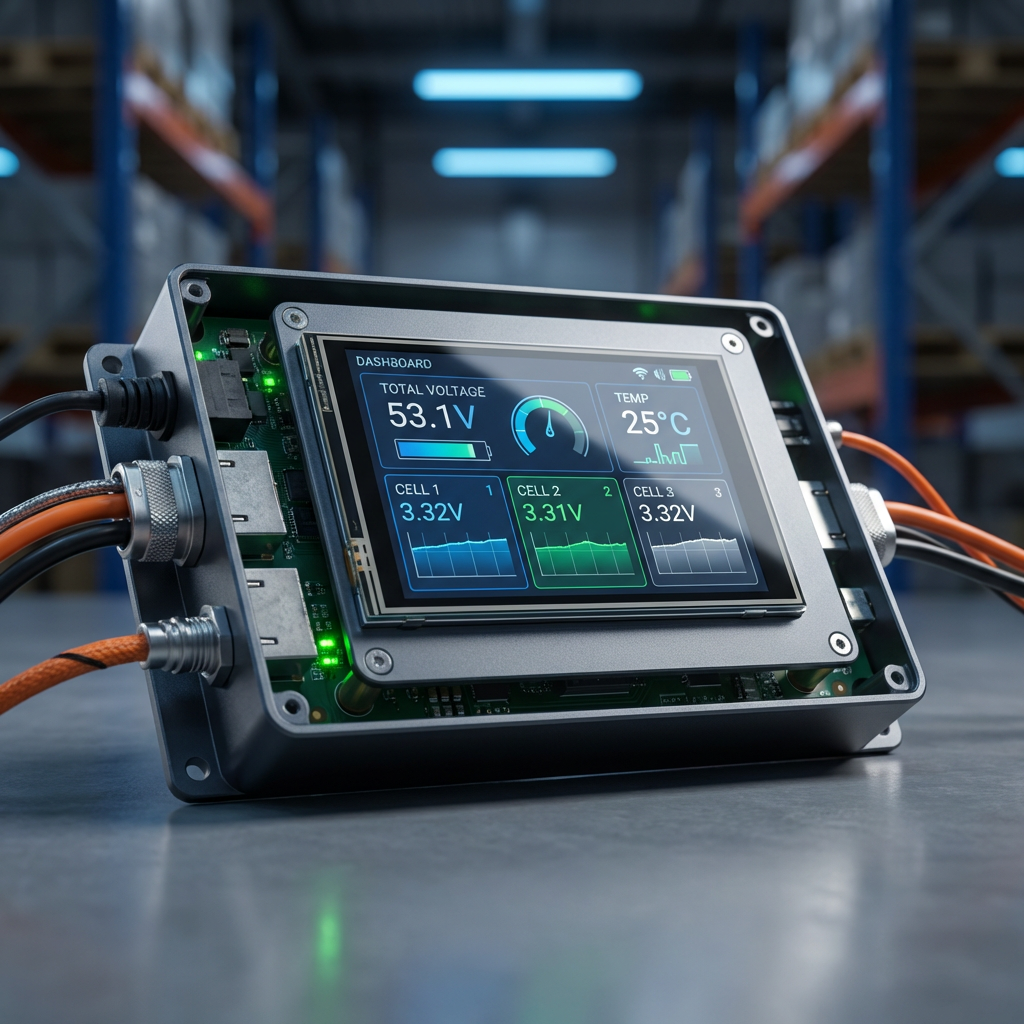
Cell imbalance is the primary cause of premature battery failure. When sixteen cells are wired in series to create a 48V/51.2V pack, small variations in internal resistance can lead to voltage drift.
- Passive Balancing: This traditional method dissipates excess energy from high-voltage cells as heat. While cost-effective, it is slow and generates unwanted thermal stress.
- Active Balancing: Premium solutions like the Jikong (JK) BMS utilize active balancing, which transfers energy from higher-voltage cells to lower-voltage ones using capacitors or inductors. This “Robin Hood” approach not only equalizes the pack faster but also improves total usable energy and reduces heat, significantly extending the system’s lifespan.
3. Thermal Runaway Management
Thermal stability is where LiFePO4 shines, but it is not immune to extreme conditions. Modern BMS units monitor temperature at multiple points across the battery bank. If the sensors detect a rapid temperature spike—a precursor to thermal runaway—the BMS initiates an emergency shutdown and can trigger external cooling systems. Advanced algorithms in 2025 are now capable of predicting thermal trends before they reach critical levels, providing an extra layer of proactive safety.
4. Communication and Monitoring
In professional B2B applications, a BMS is more than a circuit breaker; it is a data hub. Using protocols like CAN bus or RS485, the BMS communicates with the solar inverter to dynamically adjust charging rates based on the real-time health of the cells. Features like LCD screens and Bluetooth apps allow users to monitor SOC (State of Charge), SOH (State of Health), and individual cell voltages, ensuring complete transparency.
Conclusion: Why Quality Matters
At Insum Energy, we believe that a home energy storage system is only as safe as its weakest link. By integrating high-current, active-balancing BMS technology into our DIY kits, we provide the industrial-grade protection needed for residential peace of mind. Whether you are building a 14kWh backup or a 30kWh off-grid solution, the BMS is the guardian of your energy independence.
Explore our range of professional BMS and DIY LiFePO4 kits at insumenergy.com.




One Comment
Comments are closed.