Peak Shaving vs Load Shifting: How LiFePO4 Battery Storage Cuts Commercial Energy Costs in 2026
Commercial electricity costs in Europe have reached historic highs, and businesses are under more pressure than ever to reduce operational expenses. For factory owners, warehouse operators, retail chains, and agricultural businesses, energy bills can account for 10–30% of total overhead. The good news? A single LiFePO4 battery storage system deployed strategically can slash those costs by 15–40% — but only if you deploy the right demand management strategy.
In this guide, we break down two proven commercial energy strategies — peak shaving and load shifting — explain how they differ, and show you exactly which approach delivers the best return on investment for your business type in 2026.
What Are Peak Shaving and Load Shifting?
Before choosing a strategy, it is essential to understand what each approach actually does and how it interacts with your facility’s energy profile.
Peak Shaving: Flattening the Demand Spike
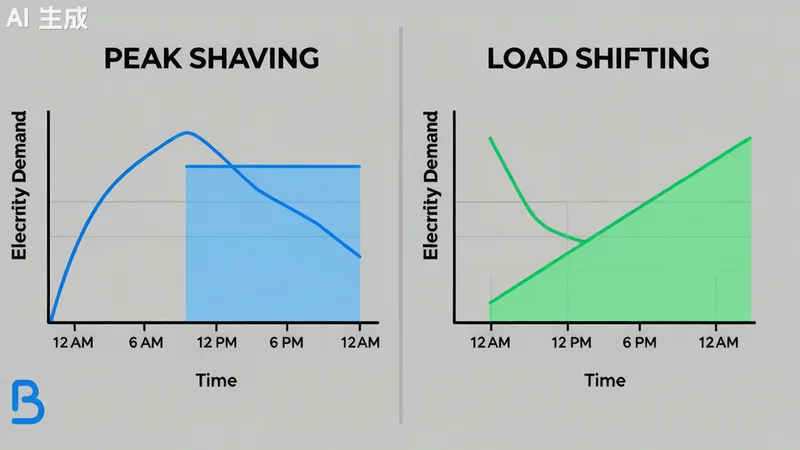
Peak shaving is the practice of reducing your facility’s maximum electricity demand during short, high-cost periods — typically the 2–4 hour windows when grid prices spike to their highest levels (often between 5 PM and 9 PM on weekdays).
Here is why it matters: in most European countries, commercial electricity pricing includes a demand charge — a fee based on your highest 15-minute power draw during the billing period. Even if your average consumption is modest, a single spike can inflate your entire bill.
With peak shaving, your LiFePO4 battery system detects when grid demand is approaching peak thresholds and automatically discharges stored energy to supplement your power draw. This flattens your demand curve and keeps you below the threshold that triggers higher demand charges.
Load Shifting: Moving Consumption to Better Hours
Load shifting (sometimes called load management or demand response) is a broader strategy that moves your facility’s energy consumption from expensive high-demand hours to cheaper off-peak hours — typically at night or during weekend periods when grid demand is low.
Rather than just dampening spikes, load shifting involves actively scheduling energy-intensive processes — such as refrigeration, HVAC, battery charging, or production line runs — to operate during low-cost windows, then using your battery to cover peak periods.
Key Differences: Peak Shaving vs Load Shifting
| Factor | Peak Shaving | Load Shifting |
|---|---|---|
| Primary Goal | Reduce demand spikes and lower demand charges | Move energy use to lower-cost hours |
| Battery Discharge Duration | Short bursts (30 min – 3 hours) | Longer periods (4 – 8 hours) |
| Ideal For | Facilities with sharp, unpredictable demand peaks | Facilities with flexible scheduling (production shifts) |
| Savings Source | Reduced demand charges + time-of-use peaks | Time-of-use arbitrage (off-peak vs peak pricing) |
| Typical ROI | 2–4 years | 3–6 years (depending on utility rate structure) |
| System Sizing | Sized to cover peak demand gap | Sized for total energy volume shifted |
For most European commercial users in 2026, a combined approach delivers the best results. Peak shaving handles the immediate demand charge problem, while load shifting maximizes time-of-use savings over the full day.
How LiFePO4 Batteries Power These Strategies
Not all battery chemistries are equally suited for demanding commercial environments. LiFePO4 batteries have become the dominant choice for commercial and industrial energy storage in 2026, and here is why:
- High cycle life: LiFePO4 cells deliver 4,000–6,000 cycles at 80% depth of discharge (DoD), making them ideal for daily charge-discharge strategies like peak shaving and load shifting. This translates to 10–15 years of reliable operation.
- Thermal stability: Unlike NMC batteries, LiFePO4 chemistry is inherently stable at high temperatures, reducing fire risk in enclosed industrial environments and lowering cooling system requirements.
- High discharge rates: Commercial LiFePO4 systems can deliver 1C continuous discharge, easily covering the short, sharp power bursts required for peak shaving.
- Modular scalability: Modern commercial LiFePO4 systems from leading brands like EVE, CATL, and REPT offer modular rack configurations that scale from 100 kWh to multiple MWh.
2026 Commercial Energy Pricing Context
Understanding current European energy pricing is essential for calculating your potential savings. As of 2026, commercial electricity prices across major European markets show the following patterns:
| Country | Avg. Commercial Rate (EUR/kWh) | Peak Rate (EUR/kWh) | Off-Peak Rate (EUR/kWh) | Demand Charge (EUR/kW/month) |
|---|---|---|---|---|
| Germany | 0.28 – 0.35 | 0.42 – 0.60 | 0.18 – 0.24 | 70 – 120 |
| France | 0.22 – 0.30 | 0.35 – 0.50 | 0.14 – 0.20 | 60 – 95 |
| Netherlands | 0.25 – 0.33 | 0.40 – 0.55 | 0.16 – 0.22 | 65 – 100 |
| UK | 0.29 – 0.38 | 0.45 – 0.62 | 0.18 – 0.25 | 80 – 130 |
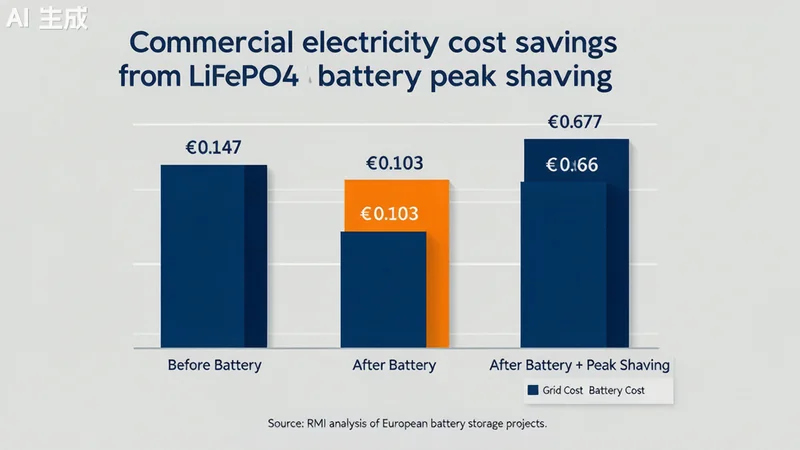
With these spreads, a 200 kW commercial facility shifting 500 kWh of daily consumption from peak to off-peak hours can save EUR 3,000–EUR 8,000 per month in energy costs alone — before factoring in demand charge reductions.
Real Business Case: Warehouse in the Netherlands
Consider a 5,000 m2 logistics warehouse in the Netherlands with 300 kW peak demand and the following energy profile:
- Annual energy consumption: 1.2 GWh
- Current annual energy cost: EUR 340,000 (incl. demand charges of EUR 95,000)
- Annual peak demand: 320 kW (triggered by loading dock operations and refrigeration)
After installing a 400 kWh LiFePO4 commercial battery system with peak shaving + partial load shifting:
- Peak demand reduced to: 180 kW (saving EUR 90/kW/month in demand charges = EUR 151,200/year)
- Time-of-use savings: 400 kWh/day shifted from peak to off-peak (saving ~EUR 18,000/year)
- Total annual savings: ~EUR 169,000
- System cost (installed): EUR 280,000
- Simple payback period: 1.7 years
This example illustrates why commercial battery storage has become one of the fastest-returning investments available to European businesses in 2026 — particularly in markets with time-of-use pricing structures and significant demand charge components.
Which Strategy Is Right for Your Business?
Choose Peak Shaving if:
- Your utility bills include significant demand charges
- Your facility has unpredictable, sharp demand spikes (e.g., motors starting simultaneously, welding equipment, compressed air systems)
- Your production schedule is rigid and cannot be shifted to off-peak hours
- You need fast ROI and have limited budget for system sizing
Choose Load Shifting if:
- Your utility offers time-of-use tariffs with wide peak/off-peak spreads
- Your facility has flexible operating hours (e.g., night shifts, weekend production)
- You run energy-intensive processes that can be rescheduled (refrigeration cycling, EV charging, thermal storage)
- You have space and budget for a larger battery system to cover extended discharge periods
Use Both if:
The most common recommendation for commercial users in 2026 is a hybrid strategy: size your battery for peak shaving first (to reduce demand charges), then configure the remaining capacity for load shifting during extended off-peak windows. Most modern BMS platforms — including those from SEPLOS and JK BMS — support automated scheduling for both strategies simultaneously.
2026 Regulatory Considerations for Commercial Battery Storage
Commercial battery installations in Europe are subject to an evolving regulatory landscape in 2026:
- EU Battery Regulation 2023/1542: All commercial LiFePO4 batteries sold in the EU must comply with due diligence requirements, and from 2027, the EU Battery Passport will require electronic documentation of battery chemistry, origin, and carbon footprint.
- Grid connection permits: In Germany, the KfW subsidy program continues to support commercial battery installations. In the UK, G99/G98 approval is required for systems above 3.68 kW. Ensure your installer handles permitting — our KfW guide covers the application process.
- VAT considerations: In the Netherlands and Belgium, businesses can recover VAT on battery storage systems, effectively reducing the net cost of installation.
Sizing Your Commercial LiFePO4 Battery System
Proper sizing is the difference between a profitable investment and an undersized or oversized system. Here is a practical approach:
For Peak Shaving:
- Review 12 months of utility bills to identify your peak demand kW
- Target a battery size that covers 70–80% of your typical peak demand gap
- Rule of thumb: 1 kWh per 2 kW of peak shaving capacity needed
For Load Shifting:
- Calculate total kWh you want to shift daily from peak to off-peak hours
- Add 10–15% buffer for round-trip efficiency losses
- Ensure your inverter capacity matches your maximum simultaneous charge/discharge needs
If you are unsure where to start, our battery sizing guide covers the core calculation principles that apply equally to commercial systems.
Conclusion: Act Before Energy Prices Rise Again
Commercial energy costs show no signs of declining. European grid operators are actively expanding time-of-use pricing structures, and demand charges are becoming more common across the continent. Businesses that invest in LiFePO4 battery storage now — with the right peak shaving or load shifting strategy — will lock in savings for 10–15 years of system operation.
The math is compelling: most commercial installations in 2026 achieve simple payback in 1.5–4 years, with annual savings that compound as electricity rates continue to rise.
Get a Custom Commercial Battery Quote
At Insum Energy, we specialize in designing and supplying commercial LiFePO4 battery storage systems tailored to your facility’s energy profile, operational schedule, and regulatory requirements. Whether you need a 100 kWh peak shaving system or a multi-MWh load shifting installation, our engineering team can deliver a solution that maximizes your ROI.
Contact us today to discuss your project:
- 🌐 www.insumenergy.com
- 📧 Email: info@insumenergy.com
- 📞 Or use our online contact form to request a tailored commercial proposal.
We offer free energy profile analysis and ROI calculations for commercial projects across Europe, the UK, Australia, and North America.