How to Design a Solar Battery Storage System for Your Home: A Complete Guide
With energy costs rising and grid reliability becoming increasingly unpredictable, more homeowners are turning to solar battery storage systems as a practical long-term investment. Designing the right system, however, requires careful planning beyond simply purchasing components. This guide walks you through the essential steps to build a solar-plus-storage setup that genuinely works for your household’s unique energy profile.
Step 1: Assess Your Energy Consumption
Before purchasing any equipment, pull 12 months of electricity bills to understand your average daily consumption in kilowatt-hours (kWh). Include seasonal variations—heating and air conditioning often create significant peaks. A typical U.S. home uses 28–32 kWh per day, though this varies widely based on home size, climate, and appliances. Knowing your baseline number prevents two common mistakes: undersizing (leading to constant grid draw and smaller savings) or oversizing (wasted capital on unused capacity). If you have a smart meter or energy monitor, use its historical data for greater accuracy.
Step 2: Define Your Goals and Backup Needs
Are you aiming for energy independence, reliable backup during outages, or simply lower monthly bills? Each objective fundamentally changes your system design:
- Bill reduction only: A smaller battery bank (5–10 kWh) with time-of-use rate optimization may suffice. The goal is to shift consumption away from peak-rate hours.
- Backup power: Plan for 24–48 hours of autonomy at minimum; 10–20 kWh of usable storage is typically the starting point, with critical loads prioritized via a subpanel.
- Full off-grid: Requires a significantly larger battery bank, generator backup for extended cloudy periods, and precise load management with headroom for growth.
Step 3: Size Your Solar Array and Battery Bank
Your solar array and battery bank must be sized together. A practical rule: your panels should generate 1.3–1.5 times your daily energy consumption to account for inverter losses, panel soiling, temperature derating, and consecutive cloudy days. Battery depth of discharge (DoD) also matters—most lithium batteries allow 80–90% DoD without significantly shortening cycle life, while lead-acid typically tops out at 50%. This means a 10 kWh lithium battery gives you 8–9 kWh of usable energy, compared to only 5 kWh from an equivalent lead-acid bank.
Step 4: Choose the Right Battery Chemistry
Lithium iron phosphate (LiFePO4) batteries have become the dominant choice for residential storage, offering the best balance of safety, longevity, and performance:
- 4,000–6,000+ cycle life at 80% DoD, translating to 10–15 years of daily use
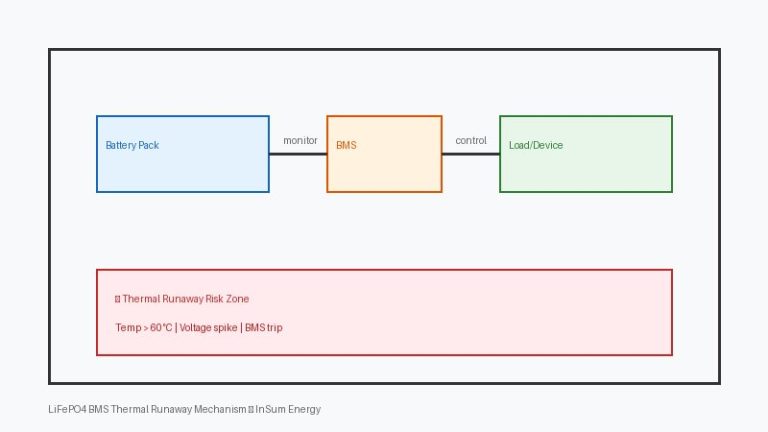
- Integrated battery management system (BMS) for overcharge, over-discharge, and temperature protection
- Thermal stability—no risk of thermal runaway, unlike NMC chemistries
- Compact, wall-mounted or floor-standing form factors that fit garages and utility rooms
- High round-trip efficiency (95–98%) meaning minimal energy loss during charge/discharge cycles
Step 5: Select a Compatible Hybrid Inverter
Hybrid inverters combine solar maximum power point tracking (MPPT), battery charging, and AC inversion into one unit—simplifying installation and reducing hardware costs. When selecting, verify that the inverter’s continuous power rating exceeds your peak simultaneous load (remember that air conditioners, well pumps, and electric dryers create high inrush currents at startup). Equally important: choose a scalable platform that lets you add battery modules as your energy needs grow, without replacing the inverter itself.
Step 6: Plan for Monitoring and Future Expansion
A quality monitoring app or portal gives you real-time visibility into energy flow, State of Charge (SoC), self-consumption rate, and bill savings. This data is invaluable for optimizing system performance. When designing, always leave expansion ports open—parallel battery connections, additional solar strings, or EV charger integration. Many homeowners add a second battery stack within two to three years as their confidence, comfort with the technology, and budget grow.
Ready to Build Your System?
Designing a solar battery storage system does not have to be overwhelming. At Insum Energy, we specialize in customized residential and commercial energy storage solutions tailored to real-world usage patterns. From initial site assessment and load analysis to equipment selection and professional installation, our team handles every step so you receive a system that is perfectly sized for your needs—not an oversized or undersized generic package.
Contact us today for a free consultation and detailed system proposal. Let us design your path to energy independence, lower bills, and a more resilient home.