Irrigation Pumping With Battery Storage: EU Farm Guide 2026
Irrigation Pumping With Battery Storage: An EU Farm Guide for 2026
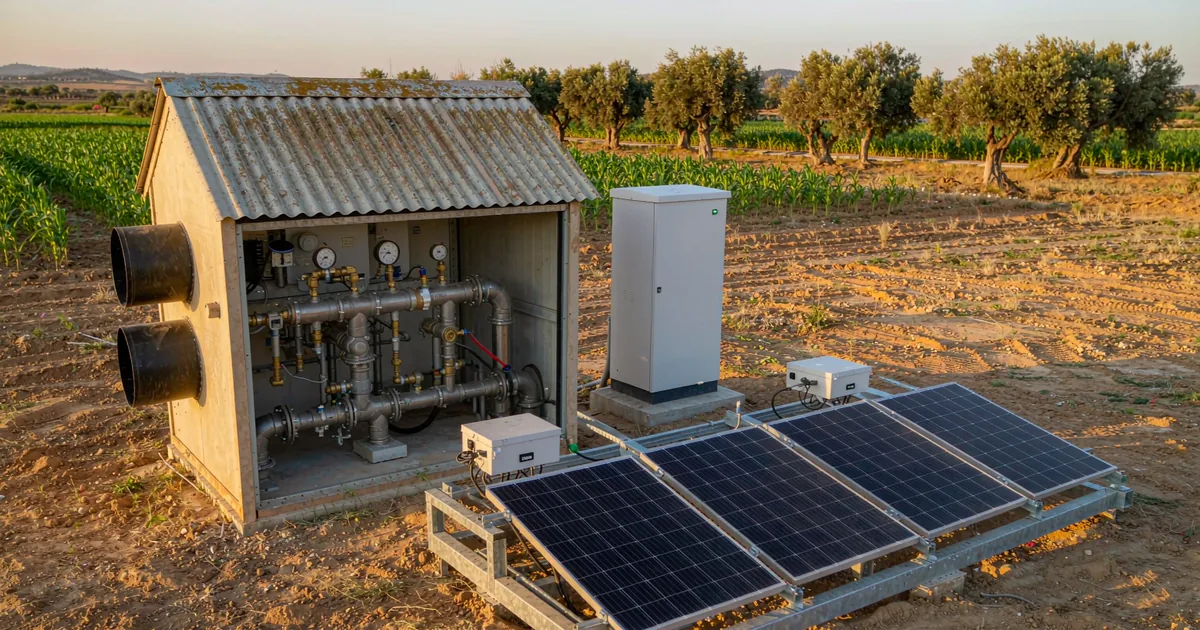
On most European farms the last piece of fossil equipment is not the tractor. It is the pump at the end of the field — a diesel unit on a trolley, or a motor hanging off a connection sized for a farmhouse forty years ago. Agriculture takes 31% of all freshwater abstraction in the EU (EEA, 2020–2023 average), and every cubic metre has to be lifted, filtered and pushed to a valve in the driest corner.
So does the battery earn its place once the pump is electric? Irrigation is the one farm load where storage is rarely the economic engine — it is what makes the rest of the design possible.
The pump is the hardest load on the farm
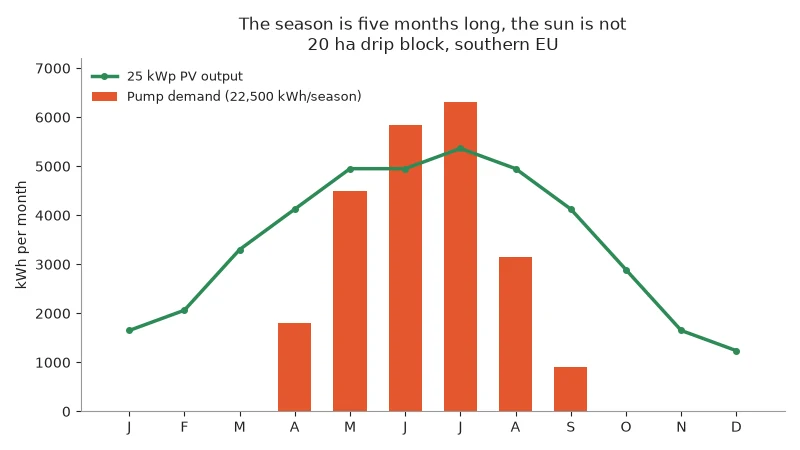
- Violently seasonal. 1,200–1,600 hours between April and September, then seven months idle. Anything sized on annual energy is wrong for half the year.
- At the worst point on the network. Fields sit at the end of long low-voltage runs, where reinforcement is dearest.
- Hard to start. A direct-on-line motor draws six to eight times full-load current for one to three seconds (IEC 60034-12) — a 22 kW pump pulling over 250 A on a 40 A supply.
- Running at night. Night irrigation is standard in southern Europe, which is exactly when PV produces nothing.
What a cubic metre of water costs in kWh
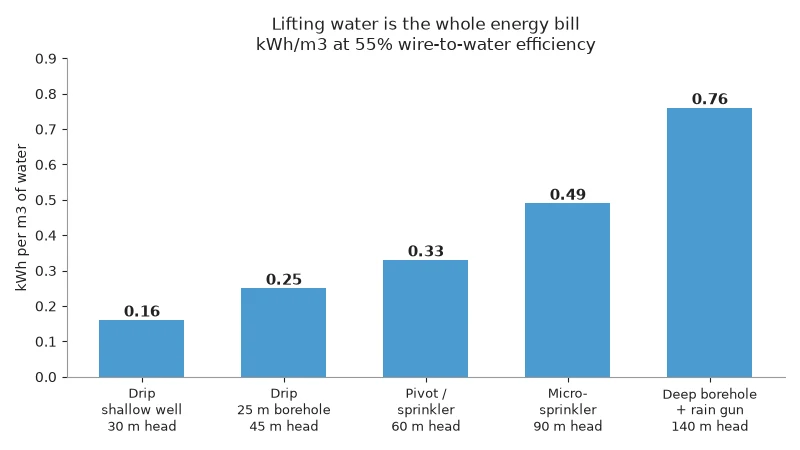
The budget reduces to one equation: kWh/m³ = total head in metres × 0.002725 ÷ wire-to-water efficiency, plus about 10% for filtration and valve losses. Head is lift plus pressure, one bar equalling 10 m.
| System | Total head | kWh/m³ | Diesel L/m³ | Diesel €/m³ | Grid €/m³ |
|---|---|---|---|---|---|
| Drip, shallow well | 30 m | 0.16 | 0.05 | €0.11 | €0.03 |
| Drip, 25 m borehole | 45 m | 0.25 | 0.08 | €0.17 | €0.05 |
| Pivot or sprinkler | 60 m | 0.33 | 0.11 | €0.23 | €0.07 |
| Micro-sprinkler | 90 m | 0.49 | 0.16 | €0.34 | €0.10 |
| Deep borehole + rain gun | 140 m | 0.76 | 0.25 | €0.53 | €0.15 |
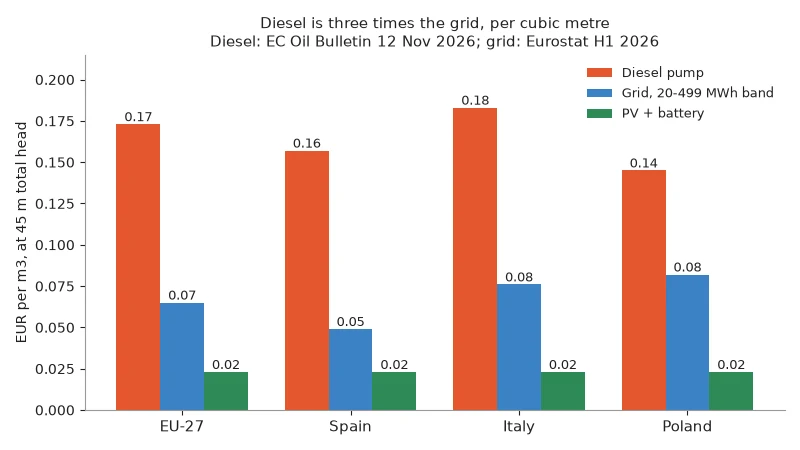
Diesel carries a second conversion. A maintained agricultural engine burns about 0.33 litres per kWh of shaft work at 60–80% load, so at the EU weighted average diesel price of €2.097 per litre (European Commission Weekly Oil Bulletin, 12 November 2026) fuel alone is roughly €0.69/kWh. The same kWh on a Spanish farm in the 20–499 MWh band costs €0.1955, in Italy €0.3041, in Poland €0.3260 (Eurostat nrg_pc_205, H1 2026, incl. taxes).
Diesel, grid or PV plus battery, per season
Three block sizes, 4,500 m³/ha, PV at €0.09/kWh delivered including battery cycling, Spanish grid tariffs. The ranking never changes.
| Block | Water per season | kWh per season | Diesel cost | Grid cost | PV + battery |
|---|---|---|---|---|---|
| 6 ha drip, 30 m | 27,000 m³ | 4,320 | €2,990 | €1,230 | €390 |
| 20 ha drip, 45 m | 90,000 m³ | 22,500 | €14,100 | €4,400 | €2,030 |
| 60 ha pivot, 60 m | 270,000 m³ | 89,100 | €55,900 | €17,400 | €8,000 |
The motor rules already changed the arithmetic
Any pump motor placed on the EU market must meet Regulation (EU) 2019/1781: IE3 from 0.75 kW since July 2021, IE4 across 75–200 kW since July 2023, IE2 maximum losses on every drive in scope. A replacement pump is therefore already efficient, so the gain from electrification is the fuel switch, not the nameplate.
The affinity laws do more than any battery: flow falls with speed, head with its square, power with its cube, so 80% speed costs 51% of the power for 80% of the water. A drive following soil moisture takes 25–40% off the season’s kWh before a panel is mounted. Buy the drive first.
Size the battery for three jobs, not for the season
This is where proposals go wrong. A battery sized to carry 22,500 kWh of seasonal demand is absurd; one cycling every kWh burns 700 cycles in five months doing work that costs more than it saves.
Job one: starting the pump
A grid-forming inverter delivers two to three times rated power for seconds, so a 30 kWh system rated 15 kW continuous carries a 22 kW pump start that a 40 A connection cannot. That is the cheapest fix for a pump that trips the supply.
Job two: riding through cloud
A pump should not stop because a cloud crossed the array: every restart costs a pressure surge and disturbs the fertigation dose. Allow 1–1.5 hours of pump load — 25–35 kWh for a 22 kW unit.
Job three: moving the evening block
Where the tariff has a peak window — Spanish 3.0TD and 6.1TD periods, Italian F1, French heures pleines — covering the 19:00–23:00 block earns the spread once a day: 150–180 cycles a season, well inside a LiFePO4 pack rated 8,000 cycles at 80% depth of discharge. On a flat farm tariff this job pays nothing, and the battery must justify itself on jobs one and two plus a fourth: the seven idle months.
No brochure mentions it. The battery must be wired to a second load — cold store, workshop, grain drier — or it is dead capital. Design the changeover at the drawing stage.
Article 15(3) of the Energy Taxation Directive 2003/96/EC lets Member States zero-rate farm fuel, so diesel looks cheaper than the pump price — but not three times cheaper.
The connection quote decides the project
The largest number is usually the grid connection, and nobody can quote it until the DSO surveys. A 20 ha block stepping from 22 kW to 40 kW can be quoted from a few thousand euro to a five-figure reinforcement, and a wait measured in seasons.
Article 6a of Directive (EU) 2024/1711 opened a third route: a flexible connection agreement, where the farm accepts a capped import and a certified power control system holds the site below it, permanently and with storage participating. For irrigation that is ideal — the pump peak is short and predictable. Where the DSO instead imposes a permanent export cap, the logic in our guide to zero-export limits and battery control applies.
What CAP money pays for — and the sentence that matters
Irrigation is the most gated investment in the CAP. Article 74 of Regulation (EU) 2021/2115 demands a notified river basin management plan (74(2)), water metering at the level of the investment (74(3)), and an ex-ante water-saving assessment for upgrades (74(4)). Rates: 80% for on-farm irrigation under 74(4), 65% for other on-farm work (74(8)); general EAFRD investment support is 65% (Article 73(4)).
Then the sentence that decides eligibility: “None of the conditions in this paragraph shall apply to an investment in an existing installation which affects only energy efficiency.” A PV array, a drive and a battery that change no pipe, nozzle or volume are energy efficiency, and the water-saving test does not bite. Change the pump curve and add a hectare, and you are back inside it — and under the Water Framework Directive 2000/60/EC status rules, possibly inside a refusal.
The 2026 farm subsidy map
Almost every headline storage subsidy is written for a dwelling, not a holding. The useful question is which door is open to an agricultural business.
| Country | Household scheme (not for farms) | Route a farm can actually use |
|---|---|---|
| Germany | KfW 442 heating subsidy | KfW 270 commercial loan, battery within a PV investment |
| France | MaPrimeRénov’ | Regional PCAE / FranceAgriMer calls; no national farm storage grant |
| Italy | Conto Termico 2.0 (thermal only) | Parco Agrisolare — roofs only, never field arrays; 2026 window closed 9 April |
| Netherlands | Salderingsregeling (ends 2026) | EIA 40% deduction, storage from 5 kW / 15 kWh |
| Poland | Mój Prąd | Energia dla wsi, 1 Oct 2026–31 Jan 2027, storage grant up to 20% |
| Spain | No national storage grant | RD 244/2019 self-consumption with surplus compensation |
| Greece | HDB 45–75% | CAP improvement plans; HDB is residential only |
| Romania | Casa Verde | AFIR rural investment programme |
| Czechia | NZÚ | Modernisation Fund calls for agricultural holdings |
Specification checklist
- Wire-to-water efficiency measured from flow and pressure logs, not the nameplate.
- Motor at IE3 minimum, IE4 in the 75–200 kW band; drive at IE2 losses or better.
- Battery at 1–1.5 hours of pump load, inverter rating at least 70% of pump kW for start support.
- Off-season load identified and changeover designed in; metering as Article 74(3) requires — see our guide to home storage metering.
- If the pump stays on diesel a few seasons, size the hybrid properly: see standby generator plus battery sizing.
Our EU power price outlook to 2030 explains why the evening spread matters more than the annual average. Farms adding glasshouse or cold-store load will find the profile logic in our greenhouse storage guide for the Netherlands and Spain transferable; cabling and permits for a field array are covered in the ground-mount solar guide.
Get the sizing right before the season starts
Insum Energy builds LiFePO4 storage rated 8,000 cycles at 80% depth of discharge, specified with the inverter headroom pump starting demands. Send your pump kW, total head, season hours and the DSO’s connection offer, and our engineers will return a sizing proposal for your block. See the product range, read how we build for European conditions, or contact the team for a quotation before next season is committed.