BTM vs FTM Battery Storage in the EU 2026: Rules & Revenue
Why the BTM vs FTM Distinction Matters in 2026
Across the European Union, commercial and industrial (C&I) battery projects are splitting into two clear models. Behind-the-meter (BTM) systems sit on the customer side of the electricity meter, while front-of-the-meter (FTM) systems connect directly to the grid. The choice is no longer just technical — it decides which EU rules apply, how much you pay in grid fees, and which revenue streams you can legally capture.
For installers, distributors and end-users planning a 2026 deployment, the difference is worth getting right before a single cell is mounted. A practical starting point is reviewing the solar + battery ROI picture across Germany, Spain, Italy and the Netherlands, because the payback math changes completely between the two models.
What Is Behind-the-Meter (BTM) Storage?
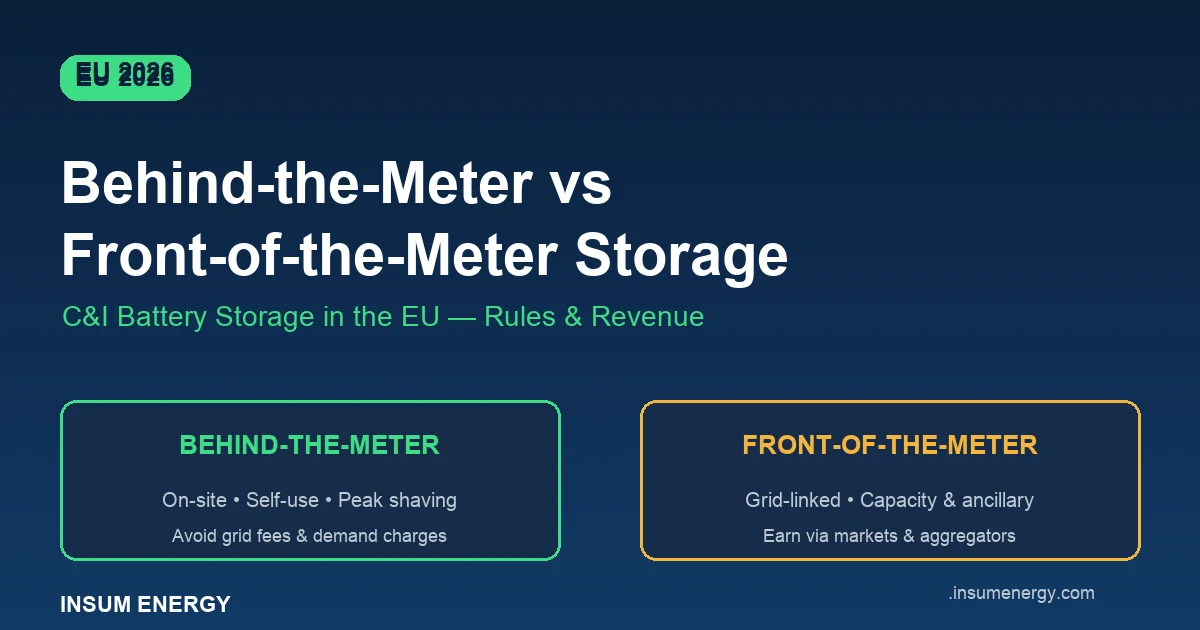
BTM storage is installed on the consumer’s premises, behind the connection point to the public grid. The battery is invisible to the wider market: it charges from on-site solar or cheap night-time grid power and discharges to cover local demand. The energy never crosses the meter, so it avoids network charges and taxes on the stored portion.
Core BTM use cases
- Self-consumption optimisation – store midday PV and use it in the evening, lifting the share of solar used on site.
- Peak shaving – clip the highest demand periods to cut capacity-based grid charges where they exist.
- Backup power – ride through outages for critical loads such as cold stores or production lines.
- Load shifting – move consumption to cheaper hours without touching the wholesale market.
In Germany, where grid fees can reach €0.06–0.13/kWh (≈€60–130/MWh) by region, that avoidance is often the single biggest saving. See our guide on peak shaving vs load shifting for commercial sites for the modelling details.
What Is Front-of-the-Meter (FTM) Storage?
FTM storage is grid-connected on the supply side. It participates in energy and balancing markets, sells services to the TSO/DSO, or feeds a community or shared asset. Here the battery is a market actor, not just a private buffer.
Core FTM use cases
- Capacity market payments – earn for being available during system stress (France, Italy, Germany, Poland, Greece).
- Ancillary services – frequency response (FCR, aFRR, mFRR) via ENTSO-E platforms PICASSO and MARI.
- Wholesale arbitrage – buy low on EPEX SPOT, sell high on the same day.
- Aggregation / VPP – pool with thousands of assets through an aggregator to reach markets a single site cannot.
FTM is where the real “energy as a service” money sits, but it carries heavier compliance. If you want the revenue side, our VPP Europe 2026 revenue guide breaks down aggregator models and realistic returns.
BTM vs FTM: Side-by-Side
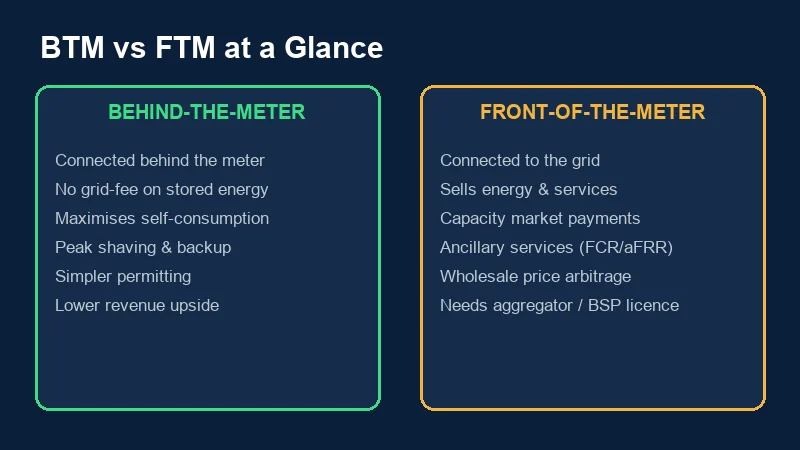
The table below is a simplification, but the direction is clear: BTM is a cost-avoidance asset, while FTM is a revenue-generation asset. In practice, the most bankable EU projects in 2026 combine both — storing on site first, then exporting surplus flexibility to the market through an aggregator. That hybrid logic is exactly what national subsidy schemes are now starting to reward.
| Dimension | Behind-the-Meter | Front-of-the-Meter |
|---|---|---|
| Connection point | Customer side of meter | Grid / supply side |
| Main benefit | Avoids grid fees & taxes | Earns market revenue |
| Permitting | Light, local DSO | Heavier, BSP / licence |
| Revenue upside | Limited (bill savings) | High (multi-stream) |
| Best for | Factories, SMEs, farms | Utilities, aggregators, large C&I |
| Key EU rule | RED III self-consumption | Network codes + market regs |
The EU Regulatory Framework You Must Respect
Both models operate under the same EU energy rulebook, but different articles bite:
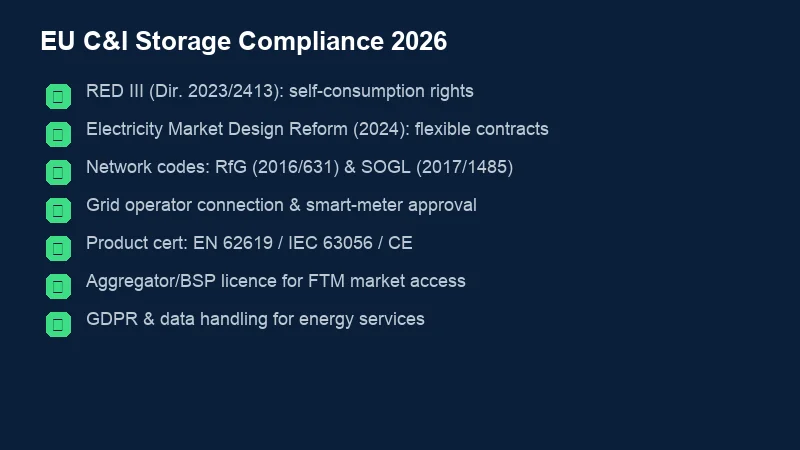
- RED III – Directive (EU) 2023/2413. Articles 15 & 16 protect renewable self-consumption and energy-community rights — the legal bedrock for BTM.
- Electricity Market Design Reform (2024). The 2024 package (Directive (EU) 2024/1745 and Regulations (EU) 2024/1746 & 1747) boosts long-term contracts, consumer flexibility and non-discriminatory market access, directly enabling storage participation.
- Network codes. Requirements for Generators Regulation (EU) 2016/631 and the System Operation Guideline Regulation (EU) 2017/1485 set the grid-code compliance bar for FTM assets.
- Balancing & settlement. The Electricity Balancing Regulation (EU) 2017/2195 governs how FTM provides reserves.
Before signing a grid-connection offer, read our grid connection capacity limits guide for 2026 — capacity queues are the number-one cause of delayed FTM projects across the EU.
EU Revenue Streams & Electricity Prices (2026 Reference)
FTM returns are built on volatile but real markets. Indicative 2026 reference values:
- Wholesale spread (EPEX SPOT). Germany day-ahead averaged ≈€80/MWh in 2024 and is projected around €75–90/MWh for 2026; France and the Netherlands (EPEX NL) sit in a similar band, while Spain’s OMIE/PVPC wholesale runs ≈€60–80/MWh with retail PVPC near €0.15–0.18/kWh.
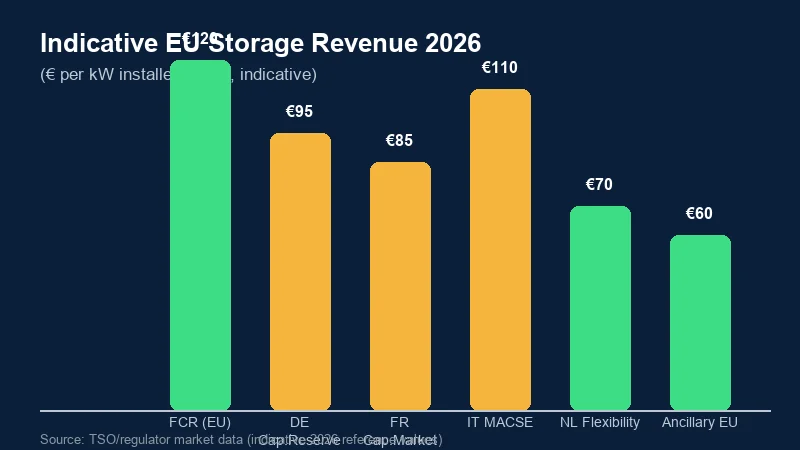
- Capacity mechanisms. Italy’s MACSE, France’s capacity market and Germany’s Kapazitätsreserve each pay for available megawatts during scarcity.
- Ancillary services. FCR across the EU historically clears at levels that can translate to roughly €100–150 per installed kW per year for fast-responding lithium batteries.
The chart above shows indicative per-kW-year figures; actual payments depend on location, speed of response and aggregator terms. Figures are indicative 2026 reference values, not investment forecasts.
Compliance Checklist for 2026
- Confirm RED III self-consumption rights with your national authority.
- Map the 2024 Electricity Market Design obligations onto your supply contract.
- For FTM: meet RfG (Regulation (EU) 2016/631) and SOGL (Regulation (EU) 2017/1485) grid codes.
- Obtain DSO connection approval and agree a smart-meter specification.
- Certify cells to EN 62619 / IEC 63056 and carry valid CE marking.
- For FTM revenue: secure an aggregator agreement or BSP licence.
- Put a GDPR-compliant data plan in place for any remote energy service.
Which Model Should You Choose?
Rule of thumb: if your goal is bill reduction and resilience, BTM wins — simpler, faster, fewer licences. If you have scale and want to monetise flexibility, FTM (often via a VPP) unlocks multi-stream revenue that BTM cannot reach. Many large sites run a hybrid: BTM for self-use plus an FTM feeder for market services.
Either way, the chemistry and BMS must be EU-market-ready. Browse our LiFePO4 storage product range built for both BTM and FTM deployments.
Get a Tailored EU Storage Quote
Choosing BTM, FTM or a hybrid is a project-specific decision driven by your tariff, grid fees and local capacity market. The team at Insum Energy sizes systems against your real load profile and national incentives. Contact us today for a no-obligation 2026 quote — or start on the homepage to explore the full storage portfolio.