
EV Charger + LiFePO4 Battery: EU Home Integration Guide 2026
Europe’s electric vehicle revolution is accelerating. With the EU’s 2035 ICE phase-out now in full effect and member states rolling out aggressive EV purchase subsidies, over 3 million new EVs were registered across the EU in 2025 alone. But as EV ownership soars, a quieter challenge is emerging: how do homeowners power these vehicles cleanly, affordably, and without overloading their grid connections?
The answer is increasingly found at the intersection of two technologies: LiFePO4 home battery storage and EV chargers. This guide explains why combining these two systems is becoming the de facto standard for forward-thinking EU households in 2026 — and how installers and homeowners can make it work.
Why EV Charging Strains the Home Grid
A standard 7 kW home AC EV charger draws as much power as a small induction hob or several bar heaters running simultaneously. In households already running heat pumps, electric water heaters, and air conditioning, adding EV charging can easily push total demand past the capacity of a standard single-phase 63 A grid connection (≈ 14.5 kW).
The problem is compounded by charging patterns. The majority of EV owners plug in during the evening peak (18:00–22:00), precisely when grid demand — and electricity prices — are highest. In Germany, spot prices on EPEX SPOT have repeatedly exceeded €0.40/kWh during these hours. In Spain under the PVPC tariff, peak rates regularly hit €0.30–€0.45/kWh.
The result: EV owners who charge from the grid alone can spend €1,200–€2,000 per year on electricity — a significant cost that erodes the financial case for going electric.
How LiFePO4 Battery Storage Changes the Equation
A LiFePO4 home battery system — typically rated at 5–15 kWh — acts as a strategic energy buffer. Instead of drawing expensive peak electricity from the grid to charge an EV, the household can:
- Charge the battery from solar during sunny midday hours (free energy)
- Charge the battery from the grid during off-peak hours (€0.08–€0.15/kWh in Germany; €0.07–€0.12/kWh in France via Tempo tariff)
- Discharge to the EV during peak evening hours, displacing expensive grid power
- Provide backup power during grid outages (common in rural France, rural Germany, and parts of Italy)
This strategy — known as peak shaving or load shifting — allows a typical EU household to reduce EV charging costs by 40–55% while extending the useful life of the battery by avoiding deep discharges.
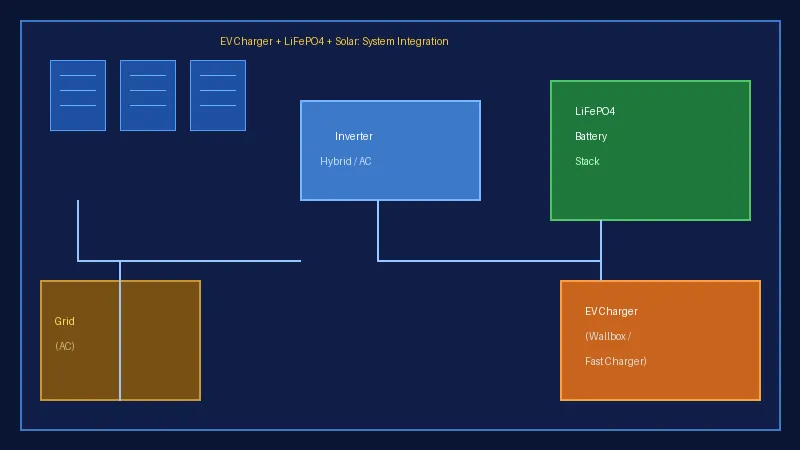
AC-Coupled vs DC-Coupled: Which Architecture to Choose?
For homes combining EV charging with battery storage, two integration architectures dominate:
AC-Coupled Systems
In an AC-coupled setup, the solar panels feed a standard string inverter, which outputs AC. A separate hybrid or battery inverter manages the LiFePO4 battery, and the EV charger is either integrated into the hybrid inverter (common in brands like Victron, SMA, and GoodWe) or operates as a separate AC device on the same bus.
Advantages: Flexible, works with existing solar installs, easy to upgrade.
Disadvantages: Double conversion losses (DC→AC→DC) when using solar to charge EV via the battery.
DC-Coupled Systems
In a DC-coupled system, solar feeds directly into a hybrid inverter with a DC battery bus. The EV charger connects to the DC bus, allowing solar energy to reach the car with only one conversion stage.
Advantages: Higher efficiency (up to 98% round-trip vs ~90% for AC-coupled), better for high-power DC chargers.
Disadvantages: More complex installation, fewer compatible products, typically higher upfront cost.
For most EU residential installs in 2026, AC-coupled systems remain the practical choice due to their flexibility and broad compatibility. However, for new builds or complete solar-plus-storage replacements, DC-coupled architectures are worth serious consideration.
Smart Charging: Managing Two Loads with One Battery
Modern hybrid inverters and battery management systems (BMS) can intelligently coordinate battery discharge between home loads and EV charging. Key features to look for include:
- Surplus solar-only EV charging — the battery only discharges to the EV when solar generation is insufficient
- Time-of-Use (ToU) optimization — the system automatically charges the battery during cheap off-peak hours and discharges during expensive peak hours, regardless of whether the EV is connected
- Dynamic grid response — some systems (e.g., Fenecon, E3/DC) support grid operators’ signals to temporarily pause EV charging in exchange for grid fee reductions
- PV surplus detection — when generation exceeds household consumption, the system routes excess power to either battery storage or directly to the EV charger
Under the EU’s Renewable Energy Directive (RED III, 2023/2413/EU), EU member states must ensure that EV charging infrastructure supports dynamic pricing signals by 2025, driving rapid adoption of smart charging protocols like OCPP 1.6J and OCPP 2.0.1 across all major European EV charger brands.
Real ROI: EV Charging Costs Across EU Countries in 2026
The financial benefit of combining LiFePO4 battery storage with EV charging varies significantly by country, driven by local electricity tariffs, solar irradiance, and battery subsidy programs.
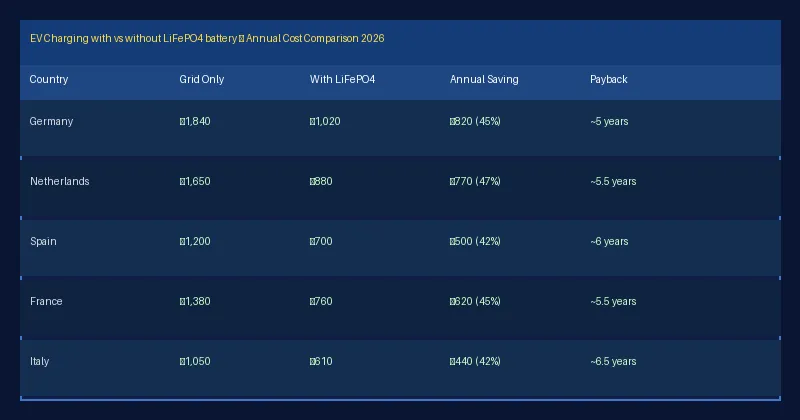
Based on 15,000 km/year of driving, a 60 kWh EV, and a 10 kWh LiFePO4 battery system, the estimated annual electricity cost for EV charging is shown above. Key observations:
- Germany: The combination saves approximately €820/year thanks to high EPEX spot prices and generous KfW 442 battery subsidies (up to €7,500 for battery + inverter packages)
- Netherlands: Despite high grid fees, the Salderingsregeling phase-out (fully gone by 2031) means self-consumption optimization is increasingly valuable; savings of ~€770/year
- Spain: Spain’s PVPC tariff with its hourly discrimination makes time-shifting highly profitable; battery storage combined with EV charging reduces costs by ~€500/year
- France: The Tempo/EJP tariff structure creates extreme off-peak vs peak spreads (as low as €0.07/kWh vs €0.55/kWh); a LiFePO4 battery system can exploit this arbitrage extremely effectively
- Italy: With Conto Termico 2.0 offering up to €5,000 for battery-plus-solar retrofits, the effective payback period drops to 5–6 years even without considering EV charging savings
EU Subsidy Programs That Cover Battery + EV Charger Combinations
Several EU member states have introduced incentive programs that effectively stack — meaning a homeowner installing solar + LiFePO4 battery + EV charger can combine multiple subsidies:
- Germany KfW 442/270: Up to €7,500 for solar-battery packages; EV charger installation may qualify under separate KfW 440 grants for electrical upgrades
- Italy Conto Termico 2.0: Up to €5,000 for thermal+electrical storage combos, including systems that support EV charging infrastructure
- Netherlands: The Investeringssubsidie duurzame energie (ISDE) covers up to 35% of battery costs; local net-billing optimization maximizes value without requiring a full net-metering arrangement
- France MaPrimeRénov’2026: The “Rénovation globale” pathway covers energy storage when combined with heat pump or insulation upgrades; EV charger eligibility is pending for 2026
- Spain: The MOVES III program covers up to 70% of battery + EV charger installation costs for individuals in some autonomous communities, though coverage varies by region
Backup Power: The Hidden Value of Battery + EV in EU Grid Stability
Grid stability events are increasing across Europe. Germany’s grid experienced 16 significant frequency deviation events in 2025, while France’s grid operator RTE issued 8 emergency demand-reduction alerts during the winter of 2025/2026. For homeowners in rural areas — where grid restoration times can exceed 4–8 hours — a LiFePO4 battery system capable of powering an EV charger is more than a convenience: it is resilience.
A 10 kWh LiFePO4 battery at 90% depth of discharge can provide:
- ~80 km of EV range for a typical 60 kWh EV (at ~18 kWh/100 km efficiency)
- Full home backup for 12–24 hours for a typical 3-person household
- Peak shaving capacity to keep the household within grid connection limits during brownout conditions
Home battery insurance and certification requirements vary by country, but for EV-capable systems, ensure your installer specifies CE marking, the relevant EU Battery Regulation 2023/1542 compliance documentation, and — where applicable — VDE-AR-E 2510-50 certification for German grid connection.
Choosing the Right LiFePO4 Battery for Your EV Charging Setup
Not all LiFePO4 batteries are equal when it comes to supporting EV charging loads. Key specifications to evaluate:
- C-Rating: Look for a battery with ≥1C continuous discharge and ≥0.5C continuous charge. For a 10 kWh battery, this means 10 kW continuous discharge and 5 kW continuous charge — sufficient to support a 7 kW EV charger while powering the home simultaneously
- Cyclic Life: Premium LiFePO4 cells (CATL, EVE, REPT) deliver 6,000+ cycles at 80% DoD, translating to 15+ years of daily use. For more on cycle life, see our guide to extending LiFePO4 battery lifespan
- Communication Protocol: The battery BMS must communicate with the hybrid inverter using CAN Bus or RS485. For EV charger integration, ensure the system supports Modbus TCP or SunSpec protocols for smart charging coordination
- Voltage Window: 48V nominal systems (51.2V) are standard for EU residential installs; they are compatible with all major hybrid inverters (Victron, SMA, GoodWe, Solis, Fenecon)
For a detailed technical comparison of BMS communication protocols, see our article on RS485 vs CAN Bus vs Modbus for LiFePO4 batteries.
Installation Best Practices for EV + Battery Systems
When installing a combined EV charger and LiFePO4 battery system, EU installers should pay particular attention to:
- Grid connection capacity assessment: A qualified electrician must verify that the existing grid connection (typically 3×25A or 3×35A for three-phase) can accommodate both loads. Grid connection capacity limits are a growing barrier in high-uptake areas of Germany and the Netherlands
- Protection devices: A dedicated Type A or Type B RCD (earth leakage protection) is mandatory for EV charger circuits under IEC 61851-1. The battery system’s DC isolation switch must be clearly labelled and accessible
- Cable sizing: A 7 kW single-phase charger requires 6mm² copper cable (or 10mm² for runs over 20m). Three-phase chargers (22 kW) require 5×2.5mm² minimum
- Communication wiring: Run a Cat6 cable between the battery BMS, hybrid inverter, and EV charger for smart load management. Many systems use this for OCPP-based charging coordination
- Notification to grid operator: In Germany, installations >3.68 kW inverter output require notification to the local grid operator (Netzbetreiber) and registration in the Marktstammdatenregister (MaStR). Similar requirements apply across all EU member states under the EU Clean Energy Package
Conclusion: The Smart Home Energy System of 2026
Combining a LiFePO4 home battery with an EV charger is no longer a luxury — it is the logical architecture for any EU household that owns or plans to own an electric vehicle. By intelligently managing when and how energy flows between solar panels, battery storage, the home, and the EV, homeowners can dramatically reduce electricity costs, gain energy resilience, and accelerate their return on investment in both solar and electric mobility.
With EU subsidies stacking in 2026 and battery prices continuing to fall, there has never been a better time to design, specify, or install this integrated system.
Ready to spec the right LiFePO4 battery for your EV charging project? Contact the Insum Energy team for a customized system proposal, volume pricing for installers, or technical support on battery + EV charger integration. Browse our full range of LiFePO4 battery products at our product page, or learn more about home energy storage in our comprehensive home battery guide.