Solar Panel String Design: How Many Panels Per String Calculator

Designing a solar energy system is not just about picking the most powerful panels. One of the most overlooked — yet critical — decisions is how many solar panels to put in each string. Get this wrong and you will waste energy, trigger inverter faults, or shorten equipment life. Get it right and your system runs at peak efficiency for decades.
In this guide, you will learn exactly what a solar string is, how inverter MPPT input windows define your constraints, and how to use our built-in calculator to size your strings correctly for any setup.
What Is a Solar Panel String?
A string is a series of solar panels connected end-to-end (in series) on a single cable run to your inverter. Each string feeds its own MPPT input channel.
Think of it like linking batteries in series: the voltage adds up while the amperage stays constant. A string of 10 × 400W panels at 40V each produces 400V and 10A — not 400W multiplied by 10.
Most residential and commercial inverters have 1 to 3 MPPT channels, and each channel accepts a string input with specific voltage and current limits. Designing your solar energy system properly means understanding these limits before you buy a single panel.
Why String Design Matters
Poor string design causes three common problems:
- Under-voltage: Too few panels leads to voltage below the MPPT minimum, and the inverter cannot start or runs inefficiently.
- Over-voltage: Too many panels pushes voltage above the MPPT maximum, risking potential damage or inverter shutdown.
- Current mismatch: String current exceeds the MPPT input rating, causing efficiency loss or safety shutdown.
In Europe especially, winter temperatures cause panel Vmp (maximum power voltage) to rise significantly. A string that works perfectly in summer can exceed your inverter maximum input voltage on a cold January morning. Cold-weather impacts on battery and panel systems are covered in our climate guide.
Key Electrical Parameters You Need
Before using the calculator, gather these specs from your equipment datasheets:
| Parameter | Where to Find It | Typical Value (Residential) |
|---|---|---|
| Panel Vmp | Panel datasheet | 30–45V (for 400–450W panels) |
| Panel Voc | Panel datasheet | 37–50V (always higher than Vmp) |
| Panel Imp | Panel datasheet | 10–13A (modern panels) |
| Panel Isc | Panel datasheet | 11–14A |
| MPPT Voltage Range (Min–Max) | Inverter datasheet | 100V–550V or 150V–800V typical |
| Max Input Current per MPPT | Inverter datasheet | 12A–25A per channel |
| Max Strings in Parallel | Inverter datasheet | Usually 1–2 strings per MPPT |
Solar Panel String Calculator — Step by Step
Step 1: Calculate Minimum Panels per String
Minimum Panels = MPPT Min Voltage ÷ Panel Vmp
Example: MPPT min = 150V ÷ Panel Vmp = 40V → 150 ÷ 40 = 3.75 → round up to 4 panels minimum
Step 2: Calculate Maximum Panels per String
Maximum Panels (Summer) = MPPT Max Voltage ÷ Panel Vmp
Example: MPPT max = 550V ÷ Panel Vmp = 40V → 550 ÷ 40 = 13.75 → round down to 13 panels maximum
Step 3: Check Cold-Temperature Voltage Rise
Panel voltage increases in cold conditions. Use this correction factor:
Vmp_Cold = Vmp × [1 + (Temp_Coeff × (25°C - coldest_operating_temp))]
Example: Vmp = 40V, Temp coeff = −0.30% per °C, Coldest temp = −10°C
Vmp_Cold = 40 × [1 + (−0.003 × 35)] = 40 × 0.895 = 35.8V (voltage rises when cold)
Recalculate max panels using cold-adjusted Vmp:
Max Panels (Cold) = MPPT Max Voltage ÷ Vmp_Cold
Then check against Voc (open circuit voltage) as well — Voc_Cold will be your highest voltage reading:
Voc_Cold = Voc × [1 + (Temp_Coeff × (25°C - coldest_operating_temp))]
Always use Voc_Cold to verify you never exceed MPPT max voltage under any condition. This is the most critical check in thermal and electrical system design.
Step 4: Check Maximum Current
String Current = Panel Imp (all panels in series carry same current)
Total MPPT Current = String Imp × Number of Parallel Strings
Example: Panel Imp = 11A, 2 strings in parallel → 11A × 2 = 22A. Verify this is within MPPT max input current.
Quick Reference String Table
| Inverter MPPT Window | Panel Vmp 38V | Panel Vmp 40V | Panel Vmp 45V |
|---|---|---|---|
| 100V–550V (entry-level) | 3–14 panels | 3–13 panels | 3–12 panels |
| 150V–800V (mid-range) | 4–21 panels | 4–20 panels | 4–17 panels |
| 200V–1000V (commercial) | 6–26 panels | 5–25 panels | 5–22 panels |
Assuming −10°C coldest operating temperature. Always verify with your actual equipment datasheet.
Real-World String Design Examples
Example 1: 10kW Residential System (Northern Europe)
- Panels: 22 × 450W, Vmp = 42V, Voc = 50V, Imp = 10.7A, Temp coeff = −0.30% per °C
- Inverter: 10kW, MPPT 150V–800V, Max input 25A per MPPT, 2 MPPT channels
- Coldest temp: −15°C (Northern Europe)
Calculations:
- Vmp_Cold = 42 × [1 + (−0.003 × 40)] = 42 × 0.88 = 36.96V
- Voc_Cold = 50 × [1 + (−0.003 × 40)] = 50 × 0.88 = 44V
- Min panels: 150 ÷ 42 = 3.57 → 4 panels
- Max panels (cold Voc): 800 ÷ 44 = 18.18 → 18 panels
- Design: 2 strings of 11 panels each → 22 total ✓
- String voltage: 11 × 42V = 462V (within 150–800V) ✓
- MPPT current: 10.7A × 2 = 21.4A (within 25A) ✓
Example 2: 5kW Small System (Southern Europe)
- Panels: 10 × 500W, Vmp = 45V, Voc = 53V, Imp = 11.1A
- Inverter: 5kW, MPPT 100V–550V, Max 15A, 1 MPPT
- Coldest temp: 0°C
Calculations:
- Vmp_Cold = 45 × [1 + (−0.003 × 25)] = 45 × 0.925 = 41.6V
- Min panels: 100 ÷ 45 = 2.22 → 3 panels
- Max panels (cold Voc): 550 ÷ (53 × 0.925) = 550 ÷ 49 = 11 panels
- Design: 1 string of 10 panels → 10 total ✓
- String voltage: 10 × 45V = 450V (within 100–550V) ✓
Common String Design Mistakes to Avoid
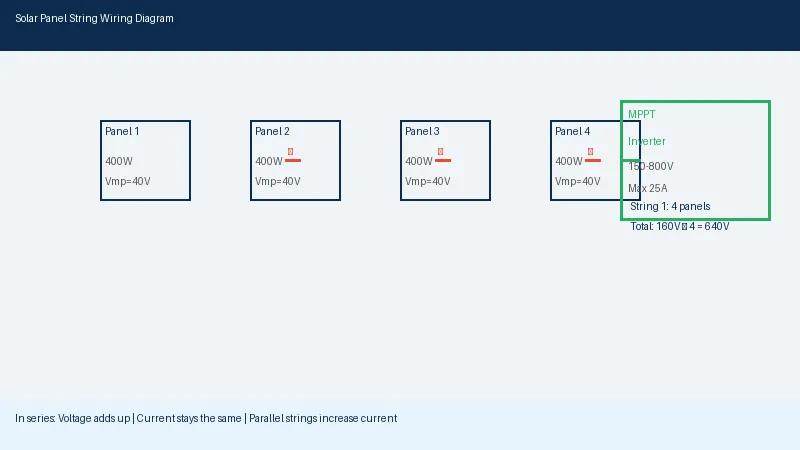
- Ignoring cold-weather voltage rise: Many installers size strings for summer conditions only. A string that works in July may exceed MPPT voltage limits in January. Always use the coldest expected temperature for your location.
- Mixing different panel models in the same string: Panels with different Vmp/Imp ratings create current bottlenecks. All panels in one string should ideally be identical. Similar matching principles apply to battery cell selection.
- Over-paralleling strings: Too many parallel strings exceed MPPT current limits and create uneven current sharing. Keep parallel strings to 2 maximum on most residential inverters.
- Forgetting Voc limits: Always check that Voc_Cold stays below the MPPT maximum. This is often lower than stated in marketing materials — check the datasheet carefully.
- Not accounting for shading: Partial shading on one panel reduces the entire string output. Use bypass diodes or string-level optimization for partially shaded arrays.
MPPT Channels: How Many Strings Can Your Inverter Handle?
Modern inverters typically have 1 to 3 independent MPPT channels. Each MPPT channel operates independently, meaning you can use different string configurations on each channel.
Practical advantages of multiple MPPT channels:
- East/west roof orientations each get their own MPPT optimized for different sun angles
- Different panel types or tilts can be connected separately
- Partial shading on one array does not drag down the other
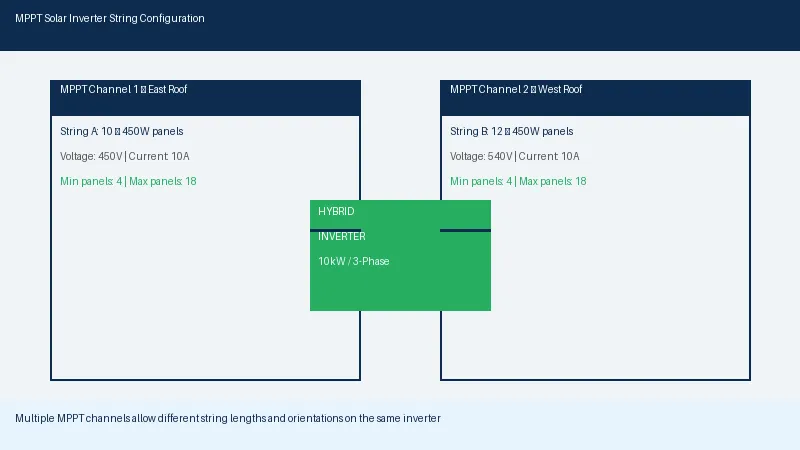
For most residential installations, a dual-MPPT inverter gives you maximum design flexibility without added complexity. If you are sizing a larger system, our guide to peak shaving and load shifting for commercial energy systems covers the additional considerations for commercial-scale string design.
How Shading Affects String Configuration
Shading is the enemy of string design. When even one panel in a series string is partially shaded, the entire string current is limited to the weakest panel. This is why string design must account for potential shading from:
- Chimneys, vents, and roof structures
- Nearby trees or buildings
- Dust and debris accumulation (more relevant in Southern Europe)
- Seasonal shading changes (sun angle varies by month)
Solutions include using optimizers or microinverters at the panel level, which allow each panel to operate independently — but these add cost. For most fixed-string systems, careful planning of string routing around shading obstacles is the most cost-effective solution.
Bottom Line: Your String Design Checklist
- ☐ Gather panel Vmp, Voc, Imp, Isc, and temperature coefficient from datasheet
- ☐ Check inverter MPPT voltage window (min/max) and max input current
- ☐ Calculate using minimum 4 panels, maximum based on cold-temperature Voc
- ☐ Verify total MPPT current does not exceed inverter limit
- ☐ Confirm all strings use identical panel specifications
- ☐ Plan for shading and consider multiple MPPT channels if needed
- ☐ Double-check all calculations with actual field measurements before installation
Need Help Sizing Your Solar System?
String design is just one piece of a properly engineered solar energy system. Getting the full picture — panels, inverter, battery storage, and grid connection — requires matching all components correctly.
At Insum Energy, our technical team specializes in complete solar and energy storage system design for homes and businesses across Europe. Whether you are installing a 5kW residential system or a 100kW commercial array, we can help you choose the right components and ensure your string configuration is optimized for maximum energy yield.
Contact Insum Energy today for a free system consultation and components quote: https://www.insumenergy.com/contact/
Want to learn more about the broader system design process? Read our complete guide to how Insum Energy approaches residential solar design and browse our full product range at insumenergy.com/product.