LiFePO4 Battery Price Trend 2026: Why Prices Are Changing
LiFePO4 (lithium iron phosphate) has become the default chemistry for home energy storage, RV and campervan systems, off-grid cabins, and telecom backup power. One reason is its outstanding safety profile; the other is price. Over the past five years LiFePO4 battery prices have fallen steeply — down more than 70% from the 2022 peak. In this guide we break down the LiFePO4 battery price trend through 2026, explain the forces pushing costs down, compare regional pricing, and give practical buying advice so you don’t overpay for your next battery bank. If you are budgeting a new install, understanding this trend is the difference between buying at the right moment and overpaying by hundreds of dollars per kWh.
The LiFePO4 Price Trend at a Glance (2021–2026)
Between 2021 and 2022, LiFePO4 cell prices spiked as lithium carbonate hit record highs above $80,000 per tonne. A typical Grade A 280Ah prismatic cell that cost roughly $95/kWh in 2021 climbed past $130/kWh by the 2022 peak. Then the market reversed hard. By 2024 cell prices had collapsed to about $50/kWh, and 2026 estimates put them near $36/kWh. Turnkey home storage systems followed the same curve: from around $480/kWh at the 2022 peak to an estimated $140/kWh in 2026.
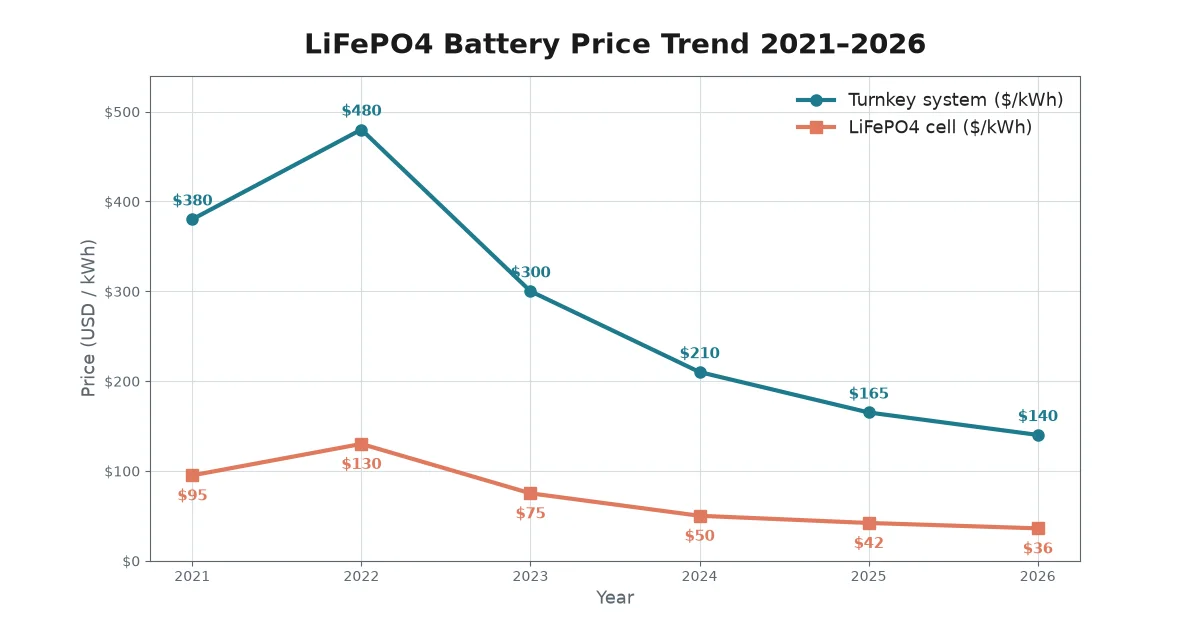
The chart above tracks both the finished system price and the underlying cell price. Because cells are the dominant cost inside any battery, the two lines move together — but system prices fall a little slower because enclosures, cabling, and labor don’t drop as fast as raw cells.
Why LiFePO4 Prices Fell So Fast
The collapse was not a single event. Four structural forces compounded over three years.
1. Lithium Carbonate Crash
After the 2022 commodity spike, lithium carbonate prices fell more than 80% as new mines and brine projects came online. Since cathode material is the largest single input for LiFePO4 cells, cheaper lithium translated directly into cheaper batteries.
2. Massive Manufacturing Scale
Chinese cell makers such as CATL, EVE, REPT, and Hithium expanded gigafactory capacity aggressively. Higher utilization drives down per-unit cost through classic learning-curve economics, and oversupply forced prices down even faster.
3. Intense Competition
A crowded field of cell and pack brands is fighting for the same residential and DIY buyers. That competition shows up as thinner margins and constant promotional pricing — good news for anyone building a LiFePO4 battery system.
4. Falling BMS & Balance-of-System Costs
Battery management systems, fuses, busbars, and inverters have all gotten cheaper and more integrated. A modern 200A smart BMS costs a fraction of what it did in 2021, trimming the total system bill.
LiFePO4 Cell Price Decline by the Numbers
Looking only at Grade A prismatic cell pricing (USD per kWh), the trajectory is striking:
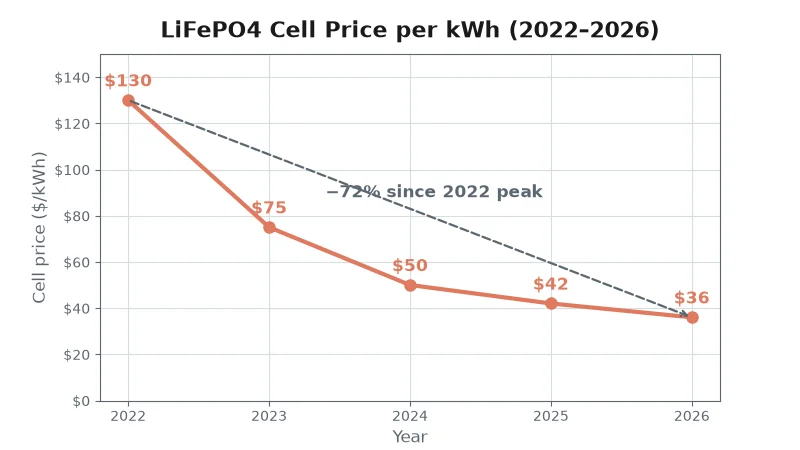
- 2022 peak: ~$130/kWh (lithium carbonate at record highs)
- 2023: ~$75/kWh (supply normalizes)
- 2024: ~$50/kWh (oversupply bites)
- 2025: ~$42/kWh (scale fully online)
- 2026 estimate: ~$36/kWh (bottoming out)
That is roughly a 72% reduction in cell cost in four years. For a real-world comparison of popular capacities, see our 280Ah vs 314Ah vs 320Ah LiFePO4 capacity test results.
Regional Price Differences in 2026
Headline cell prices are global, but the price you actually pay depends heavily on where you live. Tariffs, shipping, certification, and local labor all reshape the final number.
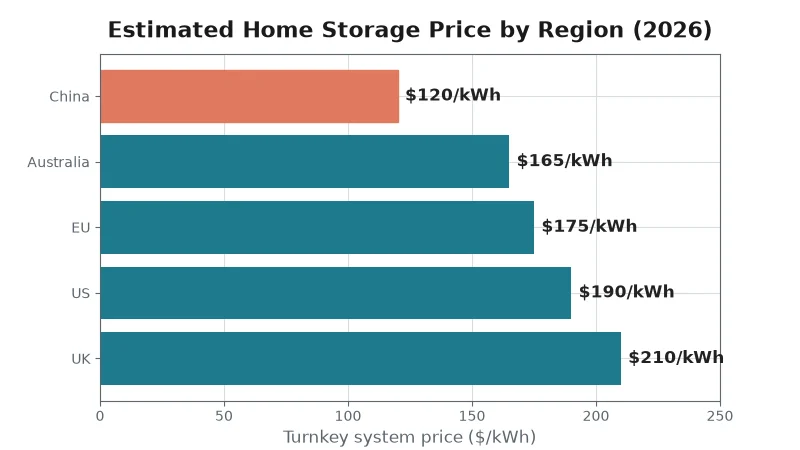
| Region | Est. 2026 System Price | Key Cost Driver |
|---|---|---|
| China | $120/kWh | Largest cell supply, lowest balance-of-system cost |
| Australia | $165/kWh | Shipping + local assembly |
| EU | $175/kWh | CE certification, VAT, distribution |
| US | $190/kWh | Tariffs, logistics |
| UK | $210/kWh | Import + certification overhead |
These figures are market estimates for turnkey residential storage and will vary by brand, volume, and installer. For a brand-by-brand breakdown, our Best LiFePO4 Battery Brand 2026 comparison is a useful next read.
Cheaper Cells Mean Faster Payback
Falling hardware cost is only half the story. Lower prices directly shorten the payback period of a solar-plus-storage system. Where a home battery might have needed 10–12 years to break even at 2022 prices, the same system at 2026 prices can pay back in 6–8 years in high-tariff markets — often without any subsidy. That shift is what turns energy storage from a nice-to-have into a clear financial decision. Pair a well-sized LiFePO4 bank with an efficient inverter and the lifetime cost per stored kWh keeps dropping as both cells and power electronics get cheaper. For most households, the question is no longer “can I afford storage,” but “how large a bank should I size.”
Is 2026 the Bottom? What to Expect Next
Most analysts expect the steep declines to flatten from here. Cell prices are approaching the marginal cost of production, so another 70% drop is unlikely. However, three variables could still move the market:
- Trade policy: New tariffs or anti-dumping duties could push prices up in the US and EU.
- Raw materials: A lithium or phosphate shortage would reverse the trend quickly.
- Demand: Grid-scale storage and EV growth are absorbing surplus capacity, which supports prices.
Net outlook: stable-to-slightly-lower through late 2026, making it a strong window to buy rather than wait.
Recycling also enters the equation. As early EV and storage packs reach end-of-life, recovered lithium and phosphate feed back into the supply chain, adding downward pressure on virgin material cost. That circular flow could extend the low-price era well beyond 2026, even if cell prices themselves stop falling.
How to Buy Smart in 2026
- Buy verified Grade A cells. Cheap “Grade B” or recycled cells undercut on price but fail on cycle life and capacity. Always verify QR codes and batch documentation before paying.
- Size to your actual load. Oversizing wastes the very savings this price drop created. Model your daily kWh before choosing capacity.
- Compare complete systems, not just cells. A low cell price can hide expensive BMS, shipping, or certification gaps. Read the full bill of materials before committing.
- Buy from a trusted supplier. Warranty, support, and certified enclosures matter more than a few dollars per kWh.
Whether you need a compact 12V setup or a full 48V whole-home bank, Insum Energy designs and supplies LiFePO4 systems built for your climate and load profile.
Get a Tailored Quote
Prices have never been better — but the right configuration still depends on your home, region, and goals. Contact Insum Energy today for a personalized quote and engineering advice, or learn more about our team. We’ll help you lock in 2026’s low battery prices with a system that lasts.