P2P Energy Trading With Home Batteries: EU Guide 2026
Across Europe, neighbours are becoming electricity suppliers. In Flanders, a household with rooftop solar can allocate its surplus to the neighbour next door at a price both choose. In Italian municipalities, energy communities earn a regulated incentive on every shared megawatt-hour. Since the 2024 EU market reform, every member state must make this possible. This is peer-to-peer (P2P) energy trading — and in 2026 it finally has the legal footing, the meters and the battery technology to work in practice.
There is one catch: solar roofs produce at noon, neighbours consume at night. Without storage, most “sharing” is an accounting fiction. A properly sized LiFePO4 home battery turns a midday surplus into an evening product you can sell. Here is how P2P trading works, what the 2026 rules require, and what a shared kilowatt-hour is worth.
What “peer-to-peer” actually means in the EU
Marketers use “P2P” loosely, so separate the three models that exist under EU law:
- Collective self-consumption. Several consumers behind the same grid connection point (a building, a street feeder or a defined radius) share one or more producers’ output through pre-agreed allocation keys — the dominant model today in France, Spain and Austria.
- Energy sharing. Introduced by Article 15a of Directive (EU) 2019/944 as amended by Directive (EU) 2024/1711, this gives active customers the right to share renewable electricity with other customers, with remuneration and grid-charge treatment set by each member state. Transposition fell in 2025, so 2026 is the first full implementation year.
- True P2P platforms. Order-book trading where households bid and offer electricity in near real time. A few pilots exist, but nowhere in the EU is this yet the mass market.
Every model must match a kilowatt-hour produced at 13:00 with one needed at 20:00 — increasingly, a battery.
Why storage decides whether sharing works
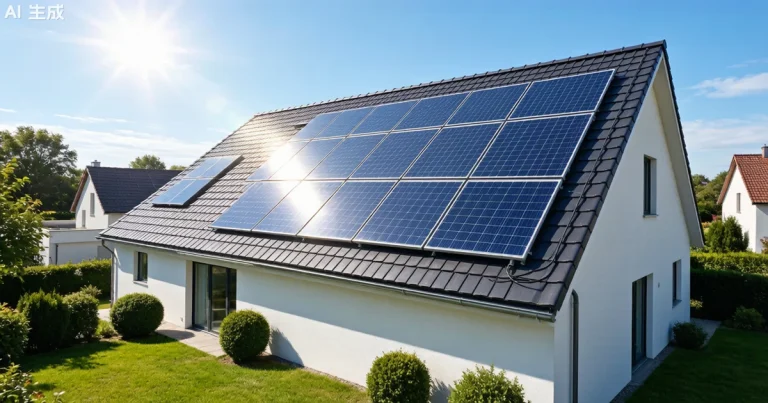
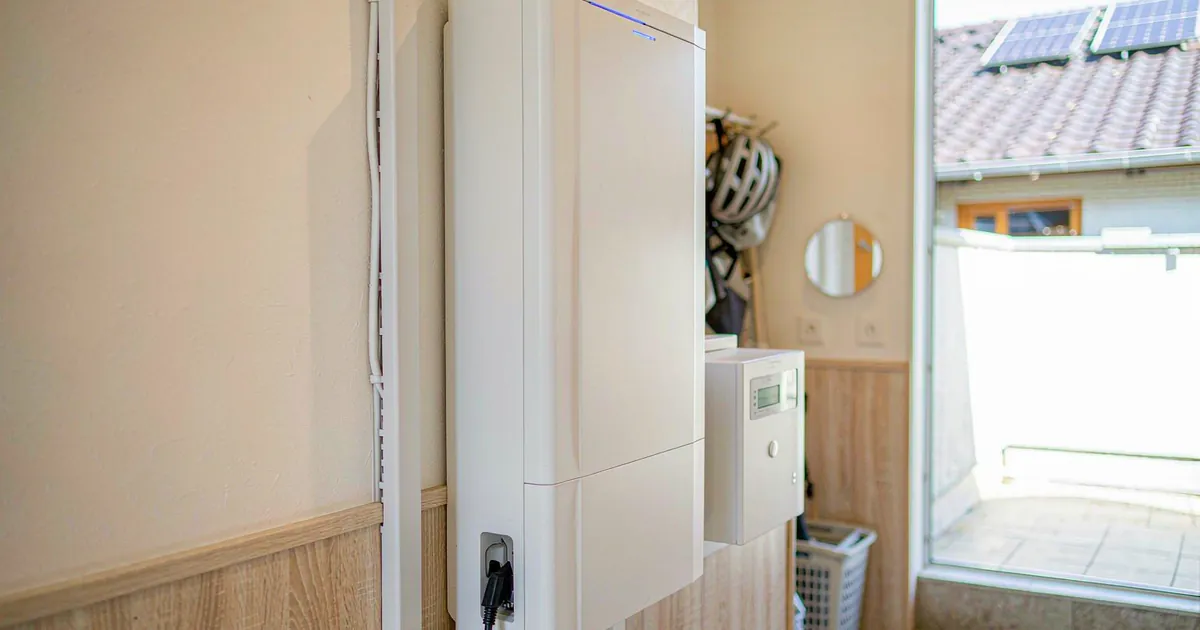
A 6 kWp rooftop system in Germany or Austria generates most of its energy between 10:00 and 15:00, when the household uses perhaps a third of it. The classic fallback — a low injection tariff — throws away most of the value. A 10 kWh LiFePO4 battery absorbs the surplus, covers the evening peak, and leaves a controllable slice to commit to neighbours.
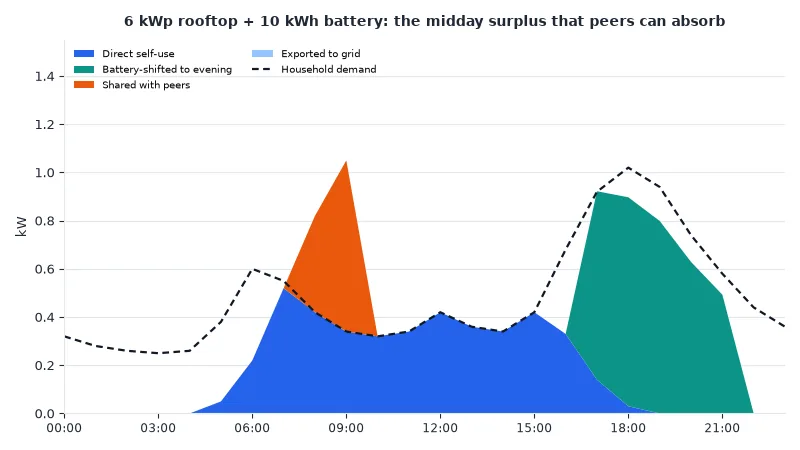
The battery changes the economics in both directions. For the seller, it converts surplus energy worth 4–8 ct/kWh from the grid into a product worth 14–20 ct/kWh to a neighbour. For the buyer, it makes the offer dependable: a sharing key backed by storage delivers electricity when the buyer needs it, not when the weather decides. For your baseline, see the self-consumption rates of solar-plus-storage across EU countries: systems without storage self-consume 30–45% of generation, battery systems 70–85% — the surplus above that is shareable.
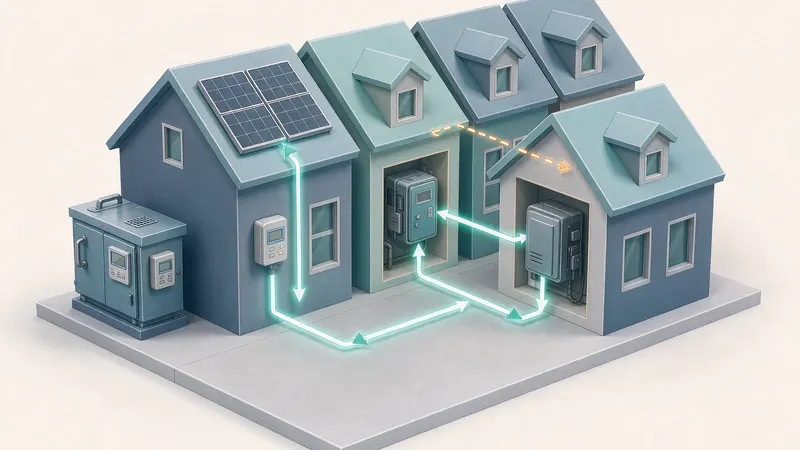
The 2026 rulebook: what EU law now requires
Three legal layers define your rights:
- Directive (EU) 2019/944, the Electricity Directive, establishes active customers (Article 15) and citizens’ energy communities (Article 16) with the right to sell flexibility.
- Directive (EU) 2024/1711, the 2024 electricity market design reform, adds Article 15a on energy sharing. Member states must allow customers to share renewably produced electricity, must not charge disproportionate grid fees on shared volumes, with transposition due in 2025.
- Directive (EU) 2023/2413 (the recast Renewable Energy Directive) protects renewable energy communities and renewables self-consumers acting together (Articles 21–22).
Metering matters as much as the directives: Annex II of Directive 2019/944 requires smart meters to deliver readings at intervals matching the balancing settlement period — in practice at least every 15 minutes. Hourly meters cannot prove when a shared kilowatt-hour was produced. Check your country’s status in our EU smart meter rollout guide before signing a sharing contract.
Country by country: where sharing is already live
| Country | Model and legal basis | Scope | 2026 status |
|---|---|---|---|
| Germany | Gemeinschaftliche Gebäudeversorgung, §42b EnWG (Solarpaket I) | One building | Live since May 2024; energy-sharing ordinance in preparation; income-tax and VAT relief for PV up to 30 kW |
| Belgium (Flanders) | Energie delen via the Fluvius portal | Same low-voltage feeder | Operational since 2023; fully digitalised allocation; no injection tariff on shared volumes |
| France | Autoconsommation collective (ACC), extended by the APER law of 2023 | 2 km, up to 20 km for renewable communities | Mature; operators such as Enogrid handle settlement |
| Austria | Gemeinschaftliche Erzeugungsanlagen (GEA), §16b EAG 2021 | Behind the same transformer station | Widely used; renewable communities (LEG) add further options |
| Spain | Autoconsumo colectivo, Royal Decree 244/2019 | Near the same transformation centre | Live; grew sharply after CNMC simplification |
| Italy | Comunità Energetiche Rinnovabili (CER), D.Lgs. 199/2021 and MASE Decree 414/2023 | Municipality or adjacent municipalities | Live since April 2024; about €110/MWh on shared energy for plants up to 200 kW, plus PNRR grants up to 40% (max €1,500 per kW) in small municipalities |
The takeaway: in half the EU you can join a working scheme today; elsewhere, transposition of Article 15a should close the gap in 2026. Larger cooperatives are covered in our guide to EU energy communities and battery storage.
What a shared kilowatt-hour is actually worth
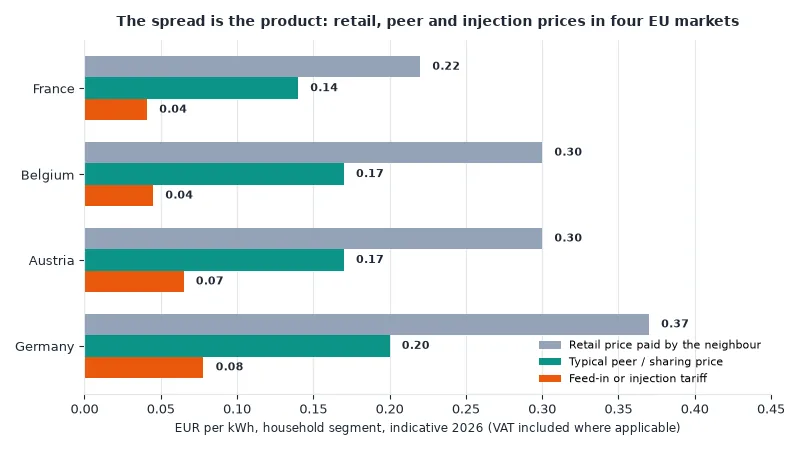
A P2P trade has three reference prices: the retail price the neighbour pays, the injection tariff the producer would otherwise get, and the peer price they agree on. The gap between them is the win to split.
A worked example: German semi-detached houses
House A has 6 kWp of solar and a 10 kWh LiFePO4 battery; House B has no roof space. Of House A’s 5,600 kWh annual production, about 1,100 kWh of genuine surplus remains after self-consumption and battery cycling. Without sharing, that surplus earns roughly €86 at Germany’s feed-in tariff of about 7.8 ct/kWh for plants up to 10 kW. Under a sharing deal at 18 ct/kWh — against a retail tariff around 37 ct/kWh — the same energy earns about €198, while House B saves about 19 ct per kilowatt-hour. Deduct a platform fee of 0.5–2 ct/kWh and the deal still clears.
Scale that to a French ACC of fifteen houses or an Italian CER with a 50 kW array — where the €110/MWh incentive stacks on the peer price — and shared-energy revenue becomes a real payback factor. Our guide to grid fees and storage in Germany and the EU covers how shared volumes are charged.
Metering, allocation keys and the battery’s role
Behind every tidy invoice sits unglamorous infrastructure:
- A registered smart meter per participant, reading at 15-minute intervals for DSO settlement.
- An allocation key — static (for example 60/40 between two households) or dynamic, following each quarter-hour’s actual surplus and demand. Dynamic keys maximise revenue but need a capable operator platform.
- Settlement by the DSO or a licensed aggregator, matching metered injection with offtake and certifying each shared kilowatt-hour.
- A battery management system that can commit capacity. If your contract promises House B 3 kWh every evening, the BMS must reserve that energy before serving your own load or responding to spot prices. Systems built for VPP participation are engineered for this coordinated dispatch.
Costs, fees and taxes to budget for
- Platform and settlement fees: typically 0.5–2 ct/kWh, or €5–15 per participant per month for cooperative schemes.
- Grid charges: Article 15a forbids double-charging network costs on shared volumes, but treatments differ: some states exempt shared energy from injection tariffs and surcharges, others apply a reduced charge.
- Taxes: in Germany, income from plants up to 30 kW is exempt from income tax (§3 No. 72 EStG) and plants below 30 kW output are generally outside VAT. France, Austria and Italy have their own regimes — confirm with a tax adviser.
- Admin reality: registration contracts and quarterly settlement — a weekend of paperwork, not an afternoon.
A practical setup checklist for 2026
- Check whether your metering area supports 15-minute settlement and a DSO sharing portal.
- Verify your country’s scope — building, feeder, 2 km or 20 km — before recruiting peers.
- Audit your surplus: a year of meter data shows what you can genuinely commit.
- Size the battery for your own evening load; sell only the verified residual surplus.
- Choose a dynamic allocation key where supported — it lifts shared volume by 15–30%.
Bottom line
P2P trading will not replace your utility in 2026, but the pieces are in place: EU-wide rights under Directive (EU) 2024/1711, 15-minute metering, and operating schemes from Flanders to Sicily. The winners are households with storage — a battery makes a noon kilowatt-hour sellable at eight in the evening. For a sharing-ready system, specify a LiFePO4 battery with open protocols, at least 10 kWh of usable capacity and a BMS that supports external dispatch.
Planning a sharing-ready solar-plus-storage system? Contact Insum Energy for a tailored quote — we help EU installers and homeowners specify LiFePO4 batteries for collective self-consumption, energy sharing and community projects. Learn more about us or explore the full range from our homepage.